
*****
Most teams discover the problem the same way: They wire up an AI agent to their Salesforce org, run a few test cases, and it works well enough to feel promising. Then, heartened by previous successes… they push it further. The agent mis-routes a lead, skips a required field, triggers a flow that was supposed to be deprecated two years ago, or confidently updates a record in a way that breaks three downstream processes no one remembered were connected.
The first instinct, of course, is to blame the model. These days, unless you’re using freeware from a shady backrooms website… the model is usually not the problem.
What the agent lacked was structural context: a working map of what the org actually looks like, how its objects relate, which automations are live, and what a change in one place does to everything else. Without that, even a capable model is working in the dark.
There is a useful analogy here, I think.
Even a genius-level new hire who has never seen your Salesforce setup will ask questions before touching anything. They want to know what the Lead Status field drives, whether that Opportunity Stage change will trigger a CPQ process, and who owns the territory assignment logic. They are building a mental model before acting.
An AI agent needs the exact thing, and it needs it instantly, at the moment of action, for every action it considers.
Agents require structured, accurate, current information about the system they are operating in. In Salesforce, that means schema, field-level dependencies, active automations, permission sets, integration touch points, and the logic layered across all of it.
Most agents get exactly zero of this. They get a natural-language description of what the CRM is supposed to do, if they get anything at all. The actual org has diverged from that description for years. That divergence is your Context Gap.
The standard advice, repeated across implementation guides and Agentforce readiness checklists, is some version of "clean up your Salesforce before you add AI." Consolidate your fields. Archive dead flows. Simplify your permission model.
That advice is not wrong, well not exactly. But treating complexity as the enemy misunderstands where the risk actually sits.
A field that looks redundant from the outside might be the one that routes enterprise deals to the right queue. A flow that appears orphaned might be the fallback for a segment your top rep owns manually. Years of custom fields, process rules, and permission exceptions are not noise. They are the recorded history of how your business actually operates.
It’s mostly problematic because it’s invisible. No agent, no admin, no newly hired RevOps manager can act safely on a system they cannot read. The goal is legibility, not simplicity.
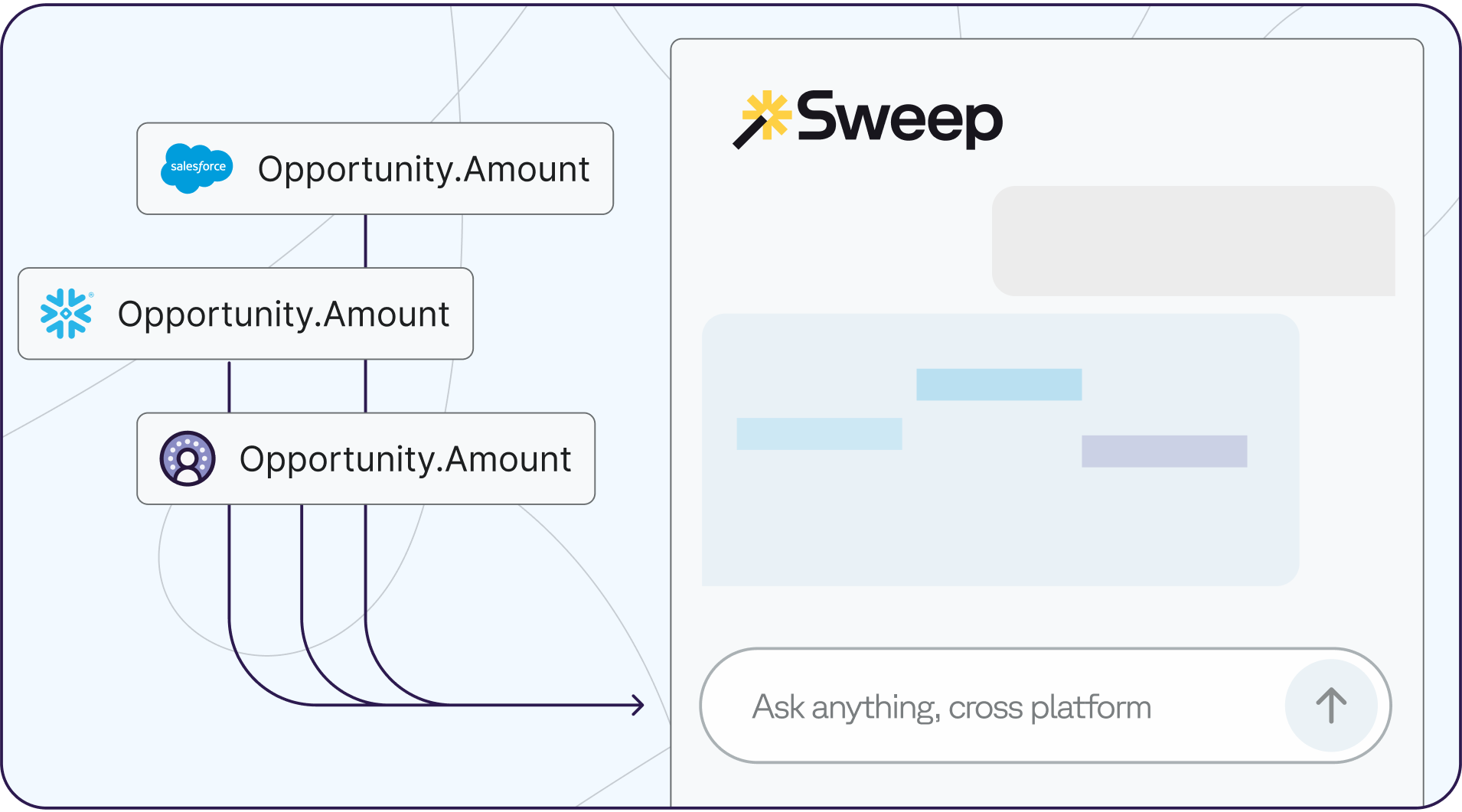
When you close the Context Gap by indexing what the org actually contains, including the complexity, agents can reason about it. They can see that changing a field will affect four flows. They can flag that a permission set is wider than it should be before a write action goes through. They can surface the dependency chain before the chain gets pulled.
This is the mechanical reason that agents fail, and it is the mechanical reason that making metadata legible is what actually reduces that failure rate.
Understanding agents failing in Salesforce means knowing which layer of the system broke down. In practice, failure concentrates in three main areas.
None of these are exotic edge cases. In any Salesforce org older than three years, all three are present, if not endemic.
The shift from "agents failing" to "agents working" is not primarily a model upgrade. It is an indexing problem. Here is what that process requires.
Sweep's Documentation Agent and Monitoring Agent address exactly this indexing layer: they read the org's metadata continuously, surface dependencies and logic that would otherwise require hours of manual investigation, and give agents and people a shared map to work from. ClearGov cut org audits from two weeks to 20 minutes using this approach. That compression is not about having a cleaner org. It is about having a legible one.
There is something ironic about how AI readiness conversations usually go. Teams spend weeks simplifying their Salesforce environment to prepare for agents, then the agents still fail because the simplified documentation does not reflect what the live system actually does.
The orgs that get agents working fastest are usually not the ones with the cleanest setups. They are the ones where the complexity has been mapped. Every custom field that represents a business rule, every deprecated-but-still-firing flow, every permission exception for a specific sales segment: all of it is context. Indexed, it is an asset. Invisible, it is the reason your agents keep making the same mistakes.
Agents failing in Salesforce is solvable. When agents can see what the system actually does, they can act on it safely, delivery timelines compress, and the weeks spent reconstructing what the system does get redirected to changing it with confidence.