Operate ServiceNow with full visibility
ServiceNow is mission-critical, but its logic becomes opaque at scale. Sweep brings ServiceNow into the Agentic Layer, providing deterministic visibility into how it operates before you make changes.
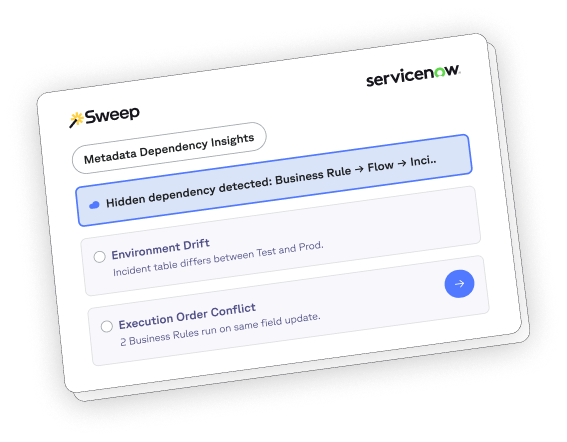
Built into Sweep’s Agentic Layer
When you connect ServiceNow, Sweep activates core Agentic Layer capabilities.
Metadata Agents & Impact Analysis
Sweep’s Metadata Agents continuously analyze your ServiceNow configuration and make them understandable in natural language. Ask questions. Explore relationships. Generate structured documentation grounded in real platform logic.
AI Documentation & Dependency Mapping
Sweep maps how metadata, automation, and configuration elements depend on one another across your instance. Before you make any changes, you can see exactly what it affects.
Visual Workspace & Metadata Maps
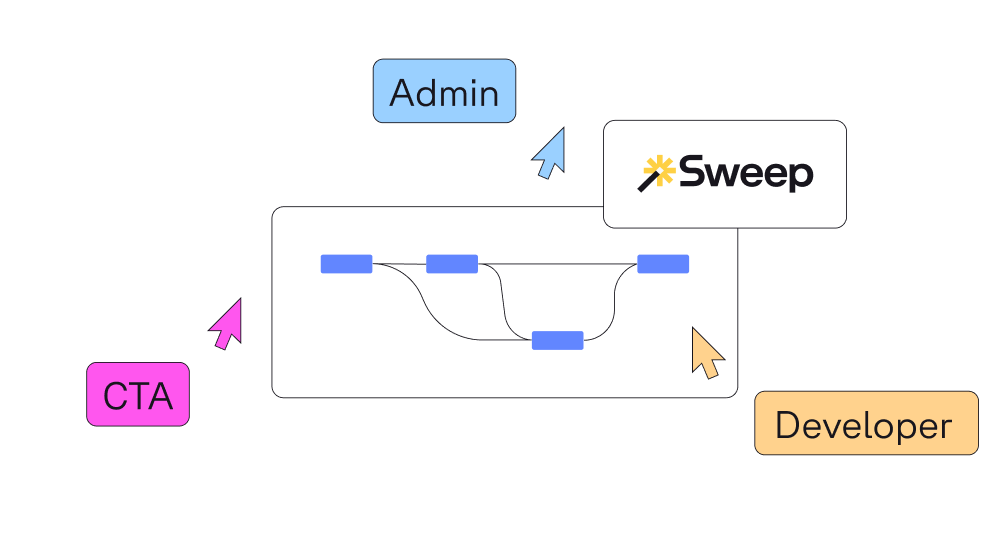
Sweep turns your ServiceNow configuration into an interactive visual workspace. Metadata Maps show how automations, configurations, tables, and access controls connect across your instance.
What you unlock with the ServiceNow Platform
Prevent release failures before they reach production
ServiceNow changes move through Update Sets and environments, dependencies across automations and configurations aren’t always obvious. A small change in Dev can trigger unintended consequences in Prod.
With Sweep, teams can ask:
- “What depends on this automation?”
- “What’s different about Incident between Dev and Prod?”
- “Which processes reference this field?”
- “What breaks if we modify this configuration?”
Result: Safer releases, fewer rollback incidents, and no last-minute production surprises.
Eliminate hidden automation conflicts
Over time, instances accumulate overlapping Business Rules, redundant Flows, legacy Client Scripts, and layered configuration changes. Execution order becomes unclear and troubleshooting becomes reactive.
Sweep makes runtime logic traceable:
- “What runs when a Change Request is created?”
- “Which automations update Priority on Incident?”
- “Are there duplicate automations touching this field?”
- “Show the full execution path for this process.”
Result: Simplified automation, reduced technical debt, and clearer operational control.
Audit access before it becomes a compliance risk
Roles, ACLs, scoped applications, and configuration settings combine to determine who can view and modify data, but those access paths are rarely transparent.
Sweep provides structural permission visibility:
- “Who can update Incident state?”
- “Which roles can bypass approval?”
- “How does access differ between Test and Prod?”
- “Document all access controls for Change Request.”
Outcome: Faster audits, clearer access governance, and fewer security blind spots.
Detect environment drift before it slows delivery
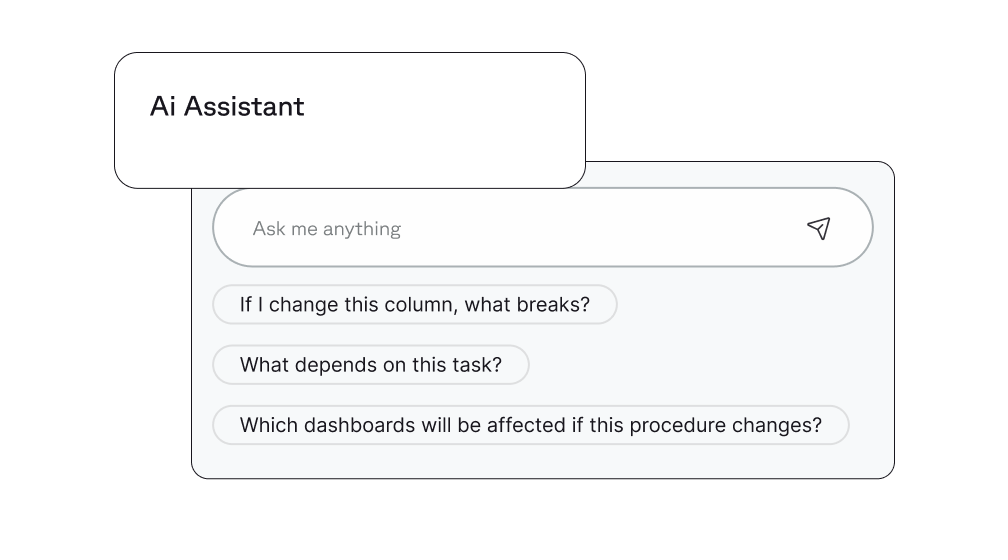
Configuration drift between Dev, Test, and Prod is one of the most common causes of release instability. Manual fixes and incomplete Update Sets make environments silently diverge.
Sweep makes drift obvious in seconds:
- “Compare the Incident table across Dev and Prod.”
- “Are there Flows in Test that haven’t been deployed?”
- “Which ACLs differ between environments?”
Get predictable release management, fewer deployment failures, and less late-night debugging.
Turn tribal knowledge into structured system intelligence
As ServiceNow instances evolve, critical logic often lives in the heads of a few administrators. Documentation becomes outdated, onboarding slows down, and understanding platform behavior requires institutional memory.
Sweep generates structured documentation directly from live configuration:
- “How does Incident lifecycle logic work?”
- “What automations run across Change Management?”
- “Document all dependencies tied to this application.”
- “Explain how access is granted for this process.”
Result: Faster onboarding, reduced key-person risk, and a shared understanding of how your ServiceNow platform actually operates.
Prepare ServiceNow for AI and advanced automation
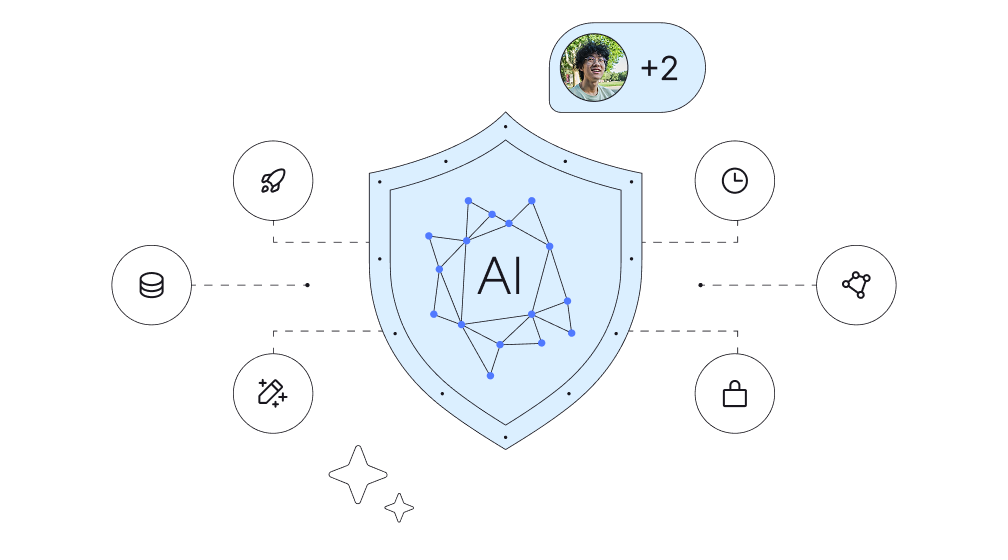
AI agents and intelligent workflows require structured system context — not just ticket data. Without visibility into automation logic, execution paths, and permissions, AI introduces risk instead of efficiency.
With Sweep, teams can ask:
- “What logic runs before an Incident is resolved?”
- “Which approvals are required before a Change moves to Implement?”
- “What permissions govern this workflow?”
- “What downstream systems depend on this SLA?"
The result: AI and advanced automation grounded in deterministic logic, governed by clear permissions, and safe to deploy at scale.
Understand your service architecture. Change it safely.
The ServiceNow Platform brings clarity to complex automation by making configuration, logic, and permissions visible inside the Agentic Layer.