
Knowledge context helps agents answer. Structural context helps them act without breaking everything.
————————
It would seem, halfway through 2026 that there’s been a consensus reached: Everyone agrees enterprise AI needs context.
That part isn’t controversial anymore. Without context, we're all starting tos ee how an agent gives generic answers, misses nuance, invents details, and (at work) fails to reflect how a business actually works.
So, the market has rushed toward the same answer: give the agent more context!
Connect it to records. Ground it in documents. Give it FAQs, tickets, meeting notes, knowledge articles, playbooks, CRM data, and support history. Make sure it can retrieve the right information before it answers. Feed the monster everything you’ve got.
It is, at time, a useful philosophy
But it’s also woefully incomplete, misleading even.
There are two very different kinds of context an enterprise agent in particular needs.
One helps it answer. Which is great. But the other? That helps it act.
The next AI moat belongs to the companies that appreciate the difference.
For the last two years, it’s safe to say that most enterprise AI projects have been judged by answer model quality. Could the model summarize the account? Explain the ticket? Generate the report? Pull together the right details from the right sources?
For the most part, we’re over that hurdle and it’s made AI relatively useful inside the enterprise.
But, agents.
Now, we must worry whether AI can take the right action inside a live business system.
That shift is already creating pressure. Gartner’s 2026 Hype Cycle for Agentic AI found that only 17% of organizations have deployed AI agents so far, while more than 60% expect to deploy them within the next two years. The ambition is moving fast! Faster than the foundation.
Gartner has also warned that by 2027, 40% of enterprises will demote or decommission autonomous AI agents because governance gaps will only become visible after production incidents. So, you know, with a grain of salt.
The risk here extends beyond A giving a wrong answer to agents acting with the wrong level of access, autonomy, or understanding.
McKinsey made a similar point from the infrastructure side. Agentic AI requires reliable operational data about assets, dependencies, ownership, logs, and metrics so automation can reduce ambiguity instead of increasing it.
In other words, the enterprise AI problem is moving from answer quality to action safety.
That is why a different kind of context needs to be considered here.
Or maybe just the definition of context has to get more precise.
Most AI context today is knowledge context. Knowledge context is what your organization knows. It lives in your records, documents, FAQs, conversations, tickets, support articles, enablement materials, policies, notes, and data tables.
It is the context that helps an agent answer a question.
Ask an agent, “What is our refund policy?” and knowledge context points it to the right policy document.
Ask, “What happened with this account?” and knowledge context pulls the CRM record, recent notes, open cases, and maybe the latest email thread.
Ask, “How should I respond to this customer?” and knowledge context gives the model enough grounding to write something relevant instead of generic.
This is the world of retrieval, grounding, and RAG. It is essential. It makes AI more accurate, more specific, and more useful.
But knowledge context is mostly about information the agent can reference.
It just tells the agent what to say, not necessarily what will happen if it does something.
That difference matters once agents move from summarizing work to changing the systems where work happens.
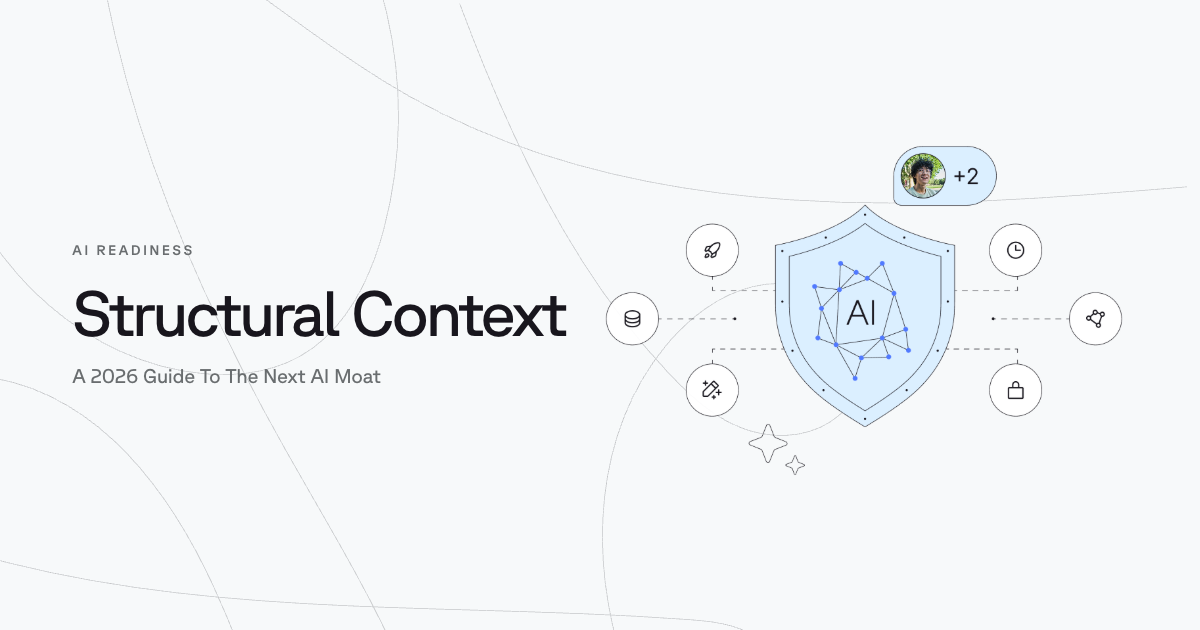
Structural context is not what your organization knows. It is how your organization actually works.
It is the shape of the system itself: the objects, fields, flows, validation rules, permissions, automations, Apex, CPQ logic, managed packages, dependencies, evaluation order, ownership gaps, and downstream effects that determine what really happens when something changes.
This is the context an agent needs before it acts.
Because in a system like Salesforce, very few changes are isolated… A field is not just a field. It may be referenced by a flow, blocked by a validation rule, hidden by a permission set, and so forth.
A status value may trigger revenue recognition, routing, approvals, renewals, forecasting, or customer communications.
A permission change can affect who sees sensitive data, who can update key records, and which business processes silently stop working.
An agent with knowledge context can explain what a field means, but an agent with structural context can understand what changing that field might break.
That is the difference between an agent that sounds informed and an agent that can safely operate inside a real enterprise org.
This is where the current AI conversation gets its most slippery: when people say agents need context, they usually mean the agent needs more information to answer with. More documents. More records. More history. More content.
Again, that is true as far as it goes.
But enterprise systems don’t fail because an agent forgot to read the FAQ. They fail when the agent doesn’t’ understand the structure it’s acting on.
It did not know that a validation rule blocks one user profile but not another.
It did not know that the value it was standardizing is hardcoded into a downstream process.
It did not know that a managed package depends on the field it was about to delete.
It did not know that the org’s actual behavior had drifted away from the documentation years ago.
The agent may have had all the knowledge context in the world, but it still lacked the structural context that would have told it, “Do not touch this until you understand what depends on it.”
Static documentation is a weak foundation for agents that act.
Documentation goes stale because systems change. Diagrams drift. Architecture notes age, often poorly. Wikis reflect what someone believed at the time they wrote them, not necessarily what the system does right now, today.
The AI research community is starting to name this problem directly. A June 2026 paper on “context rot” describes how persistent context for AI assistants can become stale as the underlying software changes. In a sample of 356 repositories, researchers found stale code-element references in 23% of them.
That problem is is familiar to anyone who has worked inside a Salesforce.
A wiki page can tell an agent what a process was supposed to do. Only the live org can tell it what actually happens when a field changes.
That is the structural context gap.
It is the space between the system as documented and the system as it behaves.
And that gap becomes dangerous when agents are allowed to act.
The usual story is that complexity gets in the way of AI. Before agents can be trusted, the thinking must go, the org must be cleaned up, simplified, documented, standardized, and made consistent.
That all sounds very fine and good, but it inevitably puts the work in the wrong order.
Your org’s complexity is a record of how the business actually runs.
Every custom object exists because somebody needed to represent something the standard model could not.
Every validation rule encodes a business constraint.
Every flow reflects a process someone decided was important enough to automate.
Some of that complexity may be redundant. Some of it may be outdated. Some of it may deserve cleanup.
But before you can clean it, govern it, or safely let agents act on it, something needs to read it.
Because complexity is information.
The clean-up-first approach creates a trap.. it tells teams they can’t trust agents until the org is totally clean. But the org is often too large, customized, and business-critical to clean manually before AI can deliver value.
So the promise of agents gets stuck behind the same backlog that slowed every other transformation project.
Document everything.
Map every dependency.
Untangle every workflow.
Resolve every ownership gap.
Then, someday, maybe, agents can be trusted.
That is backwards.
McKinsey’s aforementioned 2026 work on agent-ready infrastructure makes the more practical point: imperfect data should not prevent progress. The foundation agents need is not perfection. It is reliable operational context that reduces ambiguity and supports safe automation.
The same is true for Salesforce.
Agents need the real view of your org.
They need to understand the actual structure, not the idealized architecture diagram.
That is structural context, and it’s the context that Sweep provides.
Sweep continuously reads the structure of your enterprise systems.
In Salesforce, that means objects, fields, flows, validation rules, permissions, dependencies, Apex, CPQ, managed-package logic, and more.
This is nothing like a one-time documentation project or a static diagram that starts aging the moment it’s made.
As a continuously updated model of how the org is actually configured and how change moves through it.
That model gives agents the structural context they need before they recommend, build, modify, or deploy.
It helps them understand blast radius.
It helps them see hidden dependencies.
It helps them distinguish between a safe change, a risky change, and a change that should not happen without human review.
Most importantly, it lets agents treat complexity as signal.
The more the org has evolved, the more there is to understand. Sweep makes that structure readable.
Knowledge context will remain important. Obviously. Agents still need access to the right records, documents, business data, policies, and customer history. Better retrieval will keep making agents more useful. Better grounding will keep making their answers more accurate.
But knowledge context alone is not enough.
An agent that answers questions can survive on retrieved information.
An agent that changes enterprise systems needs to understand the structure underneath those systems.
That is the next context gap.
The gap between how your systems are supposed to work and how they actually behave.
Closing this gap is what will ultimately determine whether agents remain helpful co-pilots or become actually trusted co-operators.