
Salesforce wrote a full book of guidance on becoming an agentic enterprise. We asked a live org how it measures up, and what the road out looks like with and without Sweep.
————-
Salesforce's Agentic AI Playbook is, let’s just say, substantive…
Nine chapters, from vision statements to agent ecosystems, each ending with a worksheet you can print out and fill in with your team.
As guidance goes, it's pretty darn good. It says start with a vision before you pick technology, ground agents in data you'd actually trust, define the human handoff before the moment you need it. We'd tell you the same things.
What the playbook still cannot do is look at your org.
The most instructive parts of the playbook are the confessions.
In the chapter on data, Salesforce admits its own SDR agent initially answered "I don't know" up to 30% of the time, but that it turns out that instead of using a “smarter model” the fix was wiring the agent into integrated, context-rich data about pricing, messaging, and products. (Sounds very familiar.)
In the chapter on workflows, their support agent refused legitimate customer questions because someone had written guardrails so restrictive the agent couldn't discuss basic integrations.
In their chapter on use cases, they described reaching more than 200 internal agents performing 550 tasks, a kind of sprawl so bad they coined a term for it and built a governance program to bench the underperformers.
Let’s pause brief to notice the pattern here.
Every hard lesson in the playbook is an org discovering something true about its own systems, after launch, the expensive way.
The playbook's implied thesis is that the gap between what you believe about your org and what's actually in it is where agent projects go to perish.
Its instrument for closing that gap, though, is the Salesforce worksheet.
The vision exercise asks what leadership believes. The alignment plan asks how ready stakeholders feel. The maturity model asks where you'd place yourself. These questions are pointed at the wrong witness, we think.
Your Salesforce org already holds the answers. In its flows, its fields, its permission structure, its automations and their collisions, and the org doesn't round up.
So, we decided to ask it directly.
We pointed Sweep at a Salesforce org (a demo environment built as a mid-market security company, chosen so we could publish every number) and had it evaluate the org against all nine chapters of the playbook.
Understand your readiness before anything else. Salesforces agentic maturity model runs four levels — from foundation-stage agents answering policy questions, up to agents coordinating with other agents across companies. Most organizations start at Level 1; many Agentforce customers have reached Level 2.
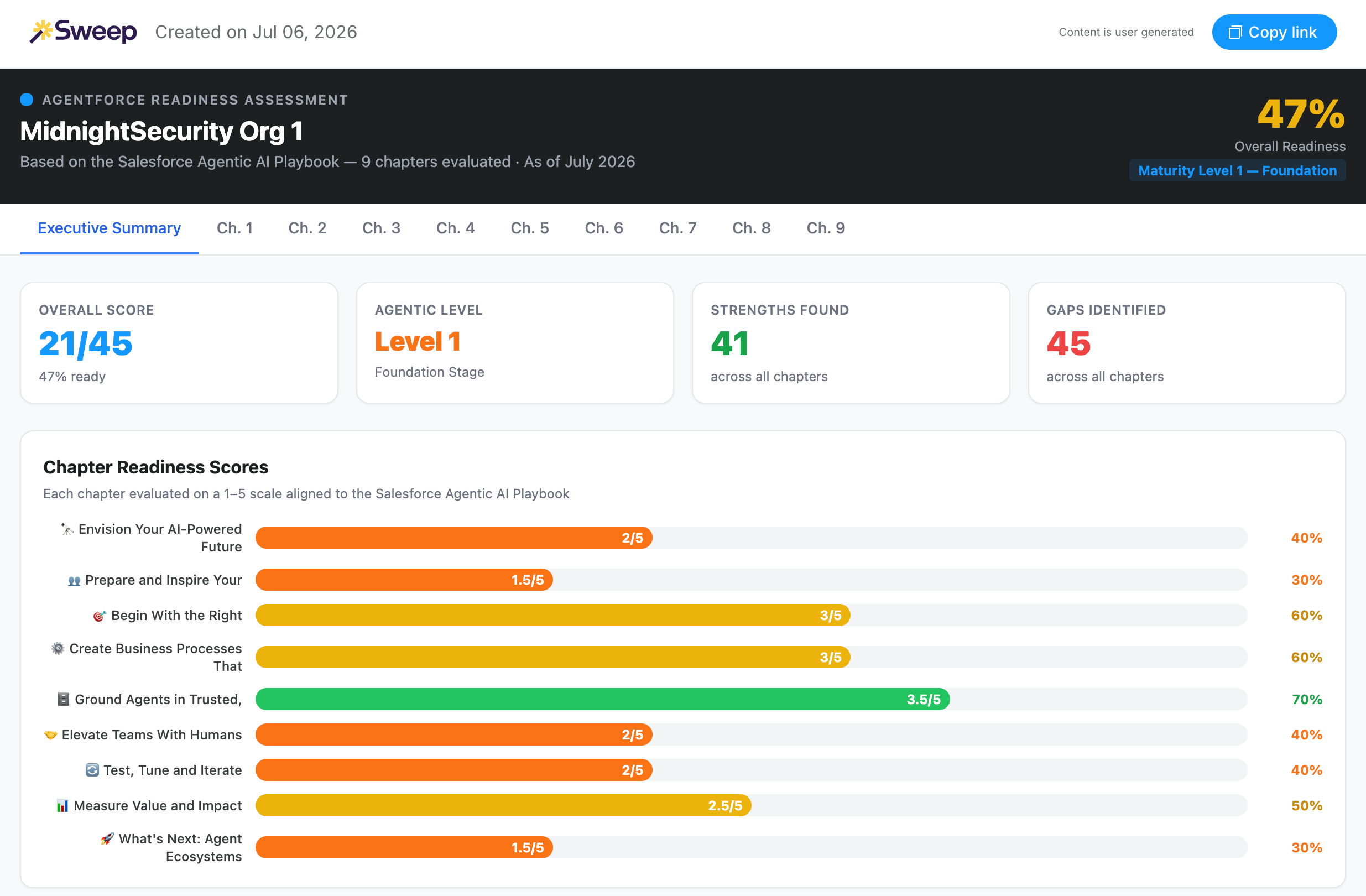
Our org's honest answer: 21 out of 45. Level 1, foundation stage. Forty-one strengths, forty-five gaps.
The chapter scores carry the real information. Data grounding scored highest at 3.5 out of 5. Also worth pausing on, because Chapter 5 is where the playbook's argument and ours converge completely…
Data access isnt enough. Agents need an ontology — a structured map of how information relates — or they can retrieve individual facts without producing meaningful answers. Salesforce compares an agent without this metadata framework to a speed-reader loose in a library with no catalog.
That's the case for structural context, we’d argue, made in Salesforce's own voice.
An agent that can query your org but doesn't understand it (say what fields mean) is a speed-reader in an uncataloged library. This org's data foundations were its strongest asset, and it still only reached 3.5.
The floor is a great deal more instructive than the ceiling on this one. People-readiness scored 1.5, the worst mark on the card, and no metadata scan fixes it …more on that below. Use-case selection and process design sat at 3. Testing, measurement, and ecosystem readiness all landed at 2.5 or lower.
It's a lower score than most teams would give themselves in a workshop. The org, for its part, simply doesn't negotiate.
An assessment tells you where you stand. The expensive question is what it takes to get out.
So, we generated that too: a full remediation plan for the same org.
Forty-eight tasks across four phases, and the arc will look familiar if you've read the playbook, because it mirrors the journey Salesforce prescribes: foundation and prerequisites first, then a single scoped agent, then scale, then measurement.
The first agent in the plan is case triage: high-volume, low-risk, measurable in weeks. That's the exact quadrant the playbook's own use-case matrix labels a quick win, the kind that builds credibility for everything after it.
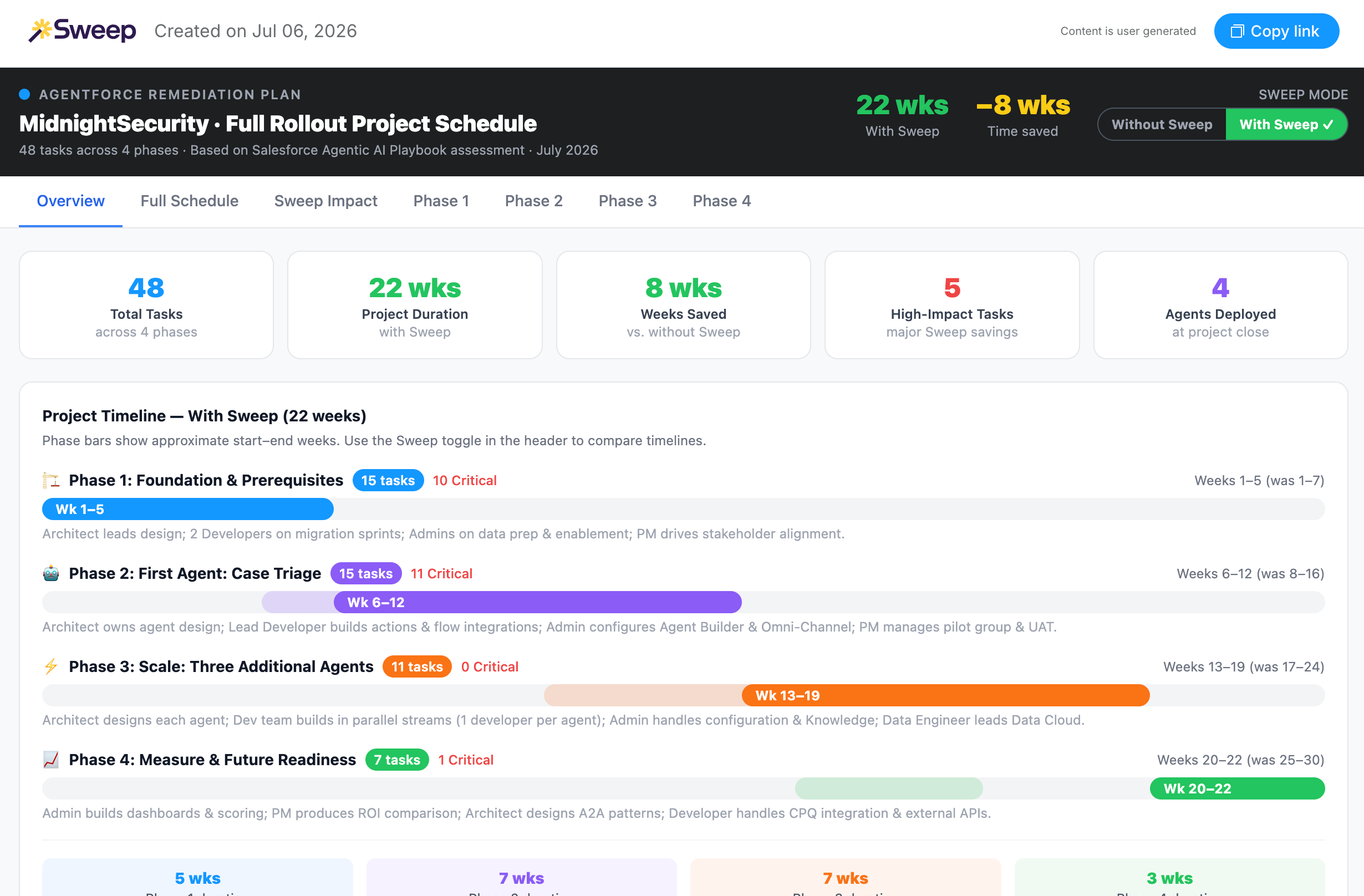
Every task has an owner across PM, architect, developer, and admin. Ten of the fifteen foundation tasks sit on the critical path, the plan is honest that the less-than-glamorous work gates everything else. It ends with four agents in prod.
If you've ever bought a scoping engagement, you know this document well. It usually arrives after weeks of discovery (interviews, org audits, a consultant tracing your automations one flow at a time). This one was generated from org-specific metadata in minutes, because the discovery is the work Sweep has already done by the time it connects.
Then, we did the part that made this worth writing up. We generated the plan twice… once with Sweep in the stack for the build, once without.
Same team. Same phases. Same four agents at the finish line.
Let’s check the scoreboard:
Without Sweep: 30 weeks.
With Sweep: 22.
Phase 1, foundation and prerequisites, drops from seven weeks to five. Phase 4, measurement and future readiness, is cut in half, six weeks to three, the steepest reduction in the plan. The middle build phases compress less: nine weeks to seven for the first agent, eight to seven for the three built in parallel after it.
Foundation and measurement are the phases made of understanding: mapping what's in the org before you touch it, tracing what your changes did after. Our State of Enterprise Systems research found roughly 80% of Salesforce work is spent understanding the org rather than changing it. Those are the hours Sweep has already absorbed. Build tasks still take what build tasks take. Discovery is the line item that shrinks.
The Phase 4 halving deserves its own sentence, because it's the phase the playbook is most insistent about.
Launch is the beginning, the work isnt. Agents degrade without continuous testing and tuning — Salesforce cut its own sales agents error rate from 30% to 17% through monitoring and iteration, and it argues that measuring outcomes, rather than activity, is what earns trust and adoption. Its measurement philosophy fits in nine words: if you cant measure it, you cant prove it.
Proving it requires knowing what changed, when, and what it touched. In a manually managed org, reconstructing that is archaeology. Sweep tracks every change as it happens, so the dashboards, the scoring, the ROI comparison (the deliverables of Phase 4) assemble from records that already exist. The measurement bill the playbook says you must pay gets paid automatically, which is why the phase takes three weeks instead of six.
Eight weeks is 27%. By the standards of AI marketing, where everything is 10x, sure, that's a modest number. It's also two months. Task-level, itemized, with five high-impact tasks accounting for most of the savings. It's a number you can defend in front of a CFO, which is the only room where a number matters.
*****
🪄 Want to go deeper? Check out our Resources Hub for our latest research.
*****
And one score barely improves at any speed. Chapter 2 of the playbook — preparing your people — is where our org scored 1.5, its worst mark, and it's the chapter no tool compresses.
The biggest barrier isnt the workforce. Citing McKinsey research, Salesforce notes that executives are twice as likely to blame employee readiness for slow AI adoption as to blame their own leadership — while the evidence points the other way. Salesforces own response was organizational, running on redesigned jobs, reskilling programs, redeployment paths, and a continuously rebalanced mix of human and digital labor.
Your admins' trust, your team's fluency with agents, the judgment about when a human overrides: that work stays yours whether the project takes 30 weeks or 22. What a shorter timeline buys you is the ability to spend the difference there, instead of on discovery. Any vendor claiming to automate Chapter 2 is just selling you Chapter 2 avoidance.
The playbook is worth your 68 minutes. Read it. Do the worksheets with your team, Salesforce's questions are the right ones.
Then ask your org whether it agrees.
Sweep runs the same nine-chapter assessment against your live metadata and builds your remediation plan (both timelines) in minutes.
You can find out more on our Agentforce Readiness tools here.