
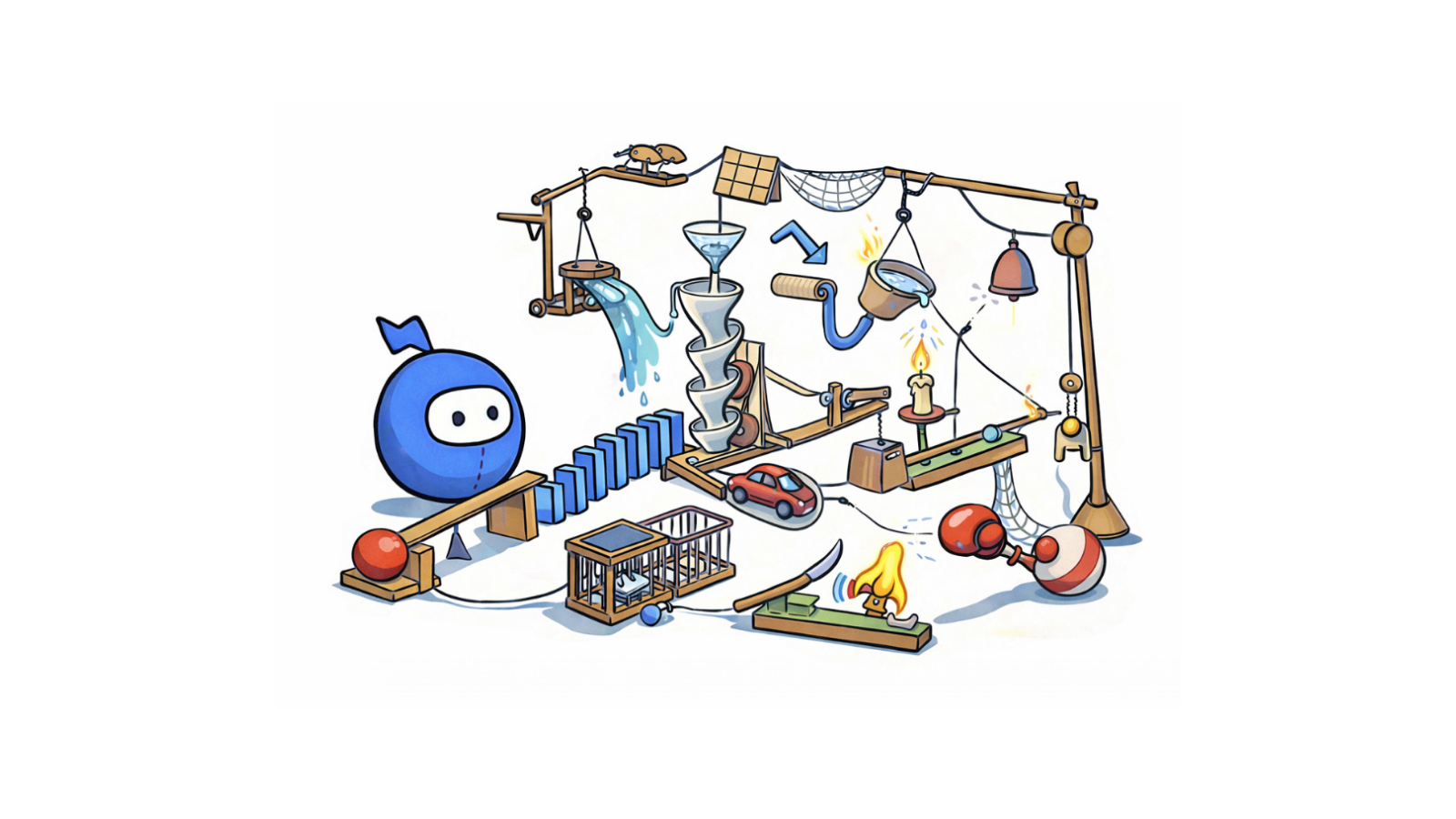
You didn't mean to build a contraption where a bowling ball triggers a pulley that lights a candle that burns a string that releases a hammer that scares a goldfish that jumps up and eventually updates a Salesforce field. And yet.. here we are. 🐟
Every Rube Goldberg machine shares the same DNA: what should be simple becomes magnificently, almost admirably, overcomplicated.
The difference? Well, Rube Goldberg machines are intentional works of art.
Your enterprise systems? Those have evolved, layer by layer, new admin by new admin. Workaround by workaround. One "quick fix" at a time.
Here are ten signs your org has become an accidental marvel of engineering mishappery:
Someone updates a single picklist value. Somewhere, a flow fires. That flow updates a field. That field triggers a process builder (yeahhhh... still). That process builder calls an Apex trigger. That trigger sends data to an integration. That integration updates another record. And now someone in Finance is asking why their dashboard changed.
In the end what's left isn't a cohesive, durable system... so much as it is a game of Mouse Trap. (And honestly, the commercials made that seem way more fun than it was.)
The original automation didn't handle a specific edge case. So someone, probably with a deadline breathing down their neck, built a workaround. But that workaround created a new edge case. So someone built a workaround for that. Now you have a flow that exists solely to undo what another flow does, but only on Tuesdays, and only for accounts created before 2019.
This is fine?
A lead comes in through your website. It hits your marketing automation platform like a bell. Ding. That syncs to Salesforce. Salesforce triggers a Zap. The Zap updates your Snowflake. Snowlfake feeds your BI tool. The BI tool sends an alert to Slack. Someone in Slack asks, "Wait, is this lead real?" The answer takes four business days to confirm because you have to trace the noodle back to the pot. This is not artistic.
There's a validation rule. It references a field that hasn't been used since 2017. It checks against a value that no longer exists in the picklist. And yet — and yet — if you deactivate it, three critical processes break.
No one knows why. No one knows who built it. The original admin left to "pursue other opportunities" (read: escaped). You've marked it DO NOT TOUCH in the description, and you pray.
Like a matchbox car that's supposed to hit a domino after a ramp, an opportunity goes into an approval process. Step one: manager approval. Step two: director approval. Step three: it routes to Janet. Wait. Janet left in 2021. (In fact, she made a really big show when she left. 👀)
The opportunity has been in Janet's queue ever since, technically "pending approval," a digital ghost haunting your pipeline reports. Damnit Janet!
You have a duplicate detection rule. Good for you. But when it fires, it creates a task for someone to review. That someone is overwhelmed, so they created an automation to auto-merge based on certain criteria. But the auto-merge sometimes gets it wrong, which creates more duplicates. Now you have a duplicate of a duplicate, and the original record is somehow marked as the duplicate. Somewhere, a data quality analyst weeps quietly into a formula.
AND( OR(ISBLANK(Custom_Field__c), LEN(Custom_Field__c) > 0), NOT(ISPICKVAL(Status__c, "")), $User.Profile.Name <> "System Administrator", TODAY() > DATE(2016, 1, 1) )
Does this make sense? No. Does it work? Somehow, yes. Will you touch it? Absolutely not.
Someone in marketing signed up for a free tool to solve a one-time problem. That tool now contains three years of campaign data, two custom integrations, and is the single source of truth for attribution.
It's on someone's personal credit card. No one has the admin login. The tool was acquired by another company last year, and you just got an email that they're "sunsetting" the feature you depend on.
This is what keeps you up at night.
Every quarter, something breaks. Not dramatically, you know, subtly. The numbers don't quite add up. A report shows different results than it did last month. An automation that definitely worked in January is now definitely not working.
So you begin the dig. And dig. And dig. You dig up layers of metadata. You uncover automations you forgot existed. You find a flow that references a field that was deleted. You discover that someone renamed an object "for clarity" and broke three integrations. By the time you find the root cause, a new quarter has started. And something else has broken.
Every Rube Goldberg system like this was built by reasonable people making reasonable decisions with the information they had at the time. No one meant to create chaos (well, maybe my little sister during Mousetrap). Ultimately, they were solving problems. Shipping features. Meeting deadlines. That's life.
The problem isn't that your people are bad at their jobs. The problem is they're doing those jobs in the dark.
You don't.
You can't untangle dependencies you can't see. You can't simplify automations you don't know exist. You can't consolidate workflows when you're discovering them for the first time during an outage.
Every "quick fix" that adds to the machine happens because someone couldn't see what was already there. Every redundant automation gets built because the original one was buried three layers deep in metadata. Every workaround-for-the-workaround exists because no one had a map of the contraption they inherited.
In the end, Rube Goldberg machine isn't the problem. The darkness is.
Turn on the lights with Sweep, and suddenly you can see that the bowling ball doesn't need to trigger the pulley. You can trace the string before you cut it. You can understand why Janet's queue still exists before you delete it and break everything. (She's never going to respond to your LinkedIn DM, by the way).
If you can't tell: Sweep gives you the light switch.
We map your Salesforce metadata — every automation, every dependency, every field relationship — so you can finally see the machine you've built. Not to judge it. Not to blow it up. But to understand it well enough to actually fix it.
Because the first step to simplifying the machine? Seeing how the whole thing works, all at once.