
Model Context Protocol gives AI agents direct access to system metadata instead of prompt fragments.
***
There's a version of AI-assisted Salesforce work that most teams are living in right now…
You paste a field list into a chat window.
You describe a flow in plain English and hope the model understands what you mean.
You copy a validation rule out of Setup, feed it to an assistant, and ask it to explain the logic.
The AI responds, you take the output, you go back to the UI, and you do something with it.
And it works. Mostly! But there's something fundamentally limited about it…
It knows what you showed it.
That gap — between what an AI can see and what it would need to see to actually reason about your system — is the gap that MCP is starting to close.
MCP stands for Model Context Protocol. If that sounds dry, that's because it is a protocol, and protocols are inherently dry. But what it enables is most definitely not.
At the most basic level, MCP is a standard that lets AI agents connect to external systems and retrieve structured information from them in real time. Instead of you copying data out of a system and pasting it into a model, the model reaches into the system directly, reads what it needs, and reasons over it in context.
MCP essentially creates the connection point between AI agents and enterprise systems. But connection alone doesn't solve the hard part. Enterprise environments still need a structured way to expose metadata relationships, dependencies, and permissions safely to those agents. Otherwise you’ve simply given a model a much larger system to misunderstand.
Think of it less like a chatbot integration and more like… giving an AI agent a playbook. It’s a set of sanctioned, structured read (and in some cases write) connections to the tools and systems it's supposed to work with.
Most AI-assisted Salesforce work today has a “context starvation” problem.
The model can generate Apex. It can write SOQL. It can describe what a flow probably does if you explain the components meticulously enough. It can suggest validation rule logic if you describe the business rules.
But it can't see your org.
It doesn't know that the field you're asking about is referenced in four different flows, two page layouts, and a process builder automation that someone built in 2019 and nobody has touched ever since. It doesn't know that the object you're changing has a dependency that crosses into a managed package. It doesn't know that the permission set you're editing is assigned to a profile that handles your entire EMEA region.
It doesn't know any of that because you didn't tell it. And you didn't tell it that information… because you might not have known either.
This is the context starvation problem. The AI is fluent. The AI is fast. But it's operating on a partial description of a system it cannot actually see.
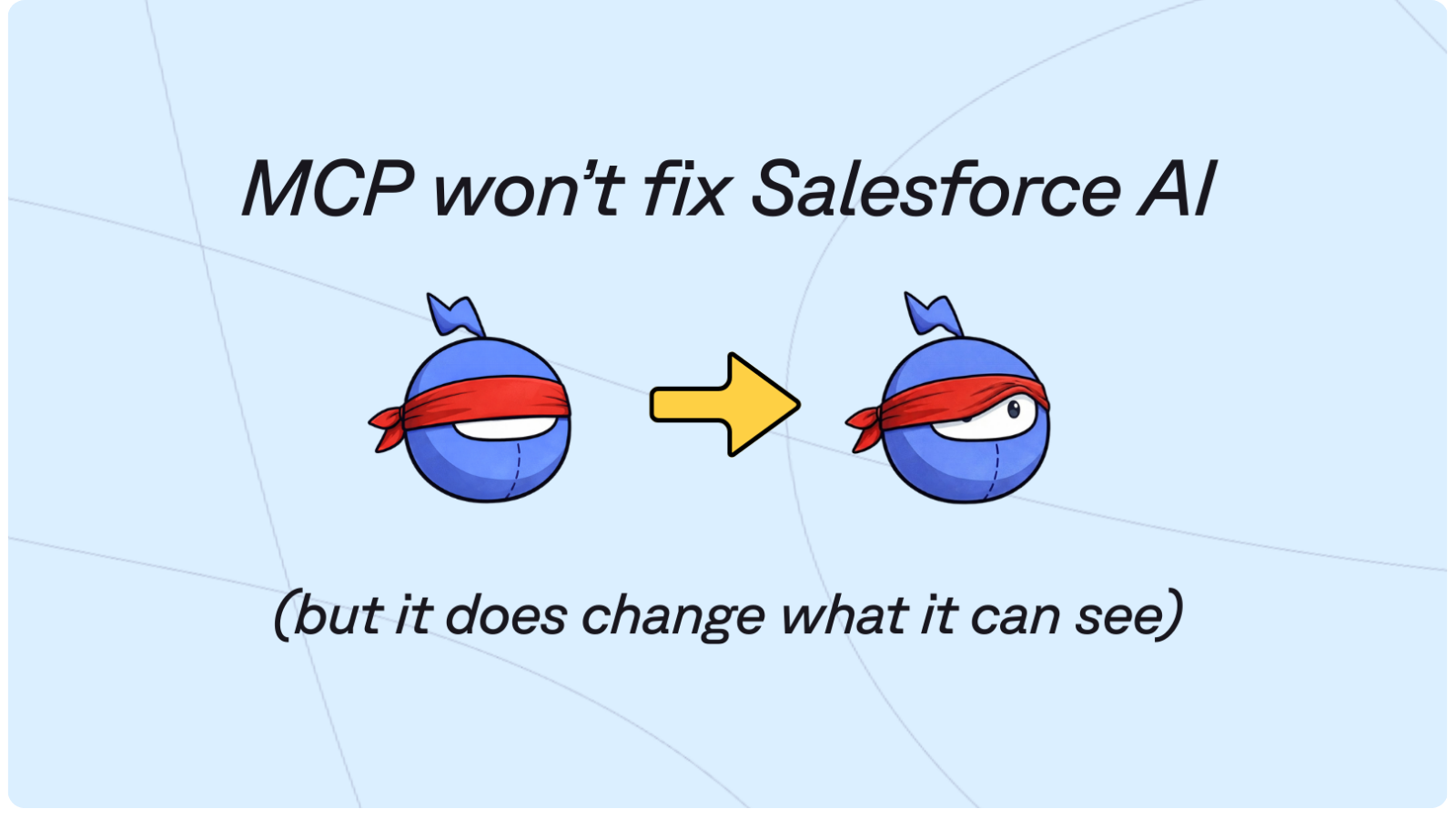
MCP changes what the model can see.
When a Salesforce environment is exposed through an MCP server, an AI agent can do something qualitatively different from what it could do before. It can query the metadata directly. It can trace a field across the objects that reference it. It can map the automations connected to a process. It can inspect permission sets, review dependencies, and surface relationships that nobody explicitly told it about.
It's not reading a description of your org. It's reading your org.
That's the difference between an AI that assists with tasks and an AI that can reason about a system.
The Reddit thread we wrote about captured a version of this already — users pulling their Salesforce work into IDEs, treating metadata as source, letting AI assistants work against repository-level context. MCP extends that instinct. The repository clone gave the AI structural visibility into a static snapshot. MCP gives it live, queryable access to the environment itself.
Naturally, this is where governance enters the conversation. And it’s not happy.
Because if an AI agent can read your Salesforce org with real structural depth — tracing fields, mapping dependencies, understanding how components relate — the next question is obvious.
Well, what can it write?
And the question after that: what happens when it gets something wrong?
This is where the chitchat around MCP in enterprise contexts gets serious fast. Read access is indeed powerful. Write access is genuinely high-stakes. An agent that can query your metadata graph and understand your dependency structure is useful. An agent that can modify configurations, deploy changes, or update permission sets with that same level of reach is something you need a governance model for.
The practitioners who've been moving work into IDEs already figured this out the hard way. Version control first. Dry runs before any write operation. Environment comparison before deployment. Automated snapshots. Change review.
In other words: you don't have to give an agent system-level access and then figure out guardrails. You build the guardrails first and then you give the agent access after.
That’s where platforms are starting to emerge that act as a governed context layer between AI agents and enterprise systems. Instead of exposing raw system access, they expose structured metadata context — dependencies, relationships, configuration state — so agents can reason about the system safely before they try to change it.
There's a version of this that stays narrow — individual practitioners wiring up personal MCP connections to their orgs, getting faster at their own work, enjoying the productivity gains.
That version is already happening.
But the version that matters at enterprise scale looks different.
An enterprise Salesforce environment isn't a single org with a clean metadata repository. It's multiple orgs. Regional deployments. Sandboxes in various states of sync with production. Acquired systems that were never fully integrated. Years of accumulated customization that exists somewhere between institutional memory and technical debt.
When an AI agent can read one org through MCP, that's a productivity story.
When it can read across environments — compare configurations, detect drift, map cross-org dependencies, explain what changed and why — that becomes something else.
This is the direction tools like Sweep are pushing toward: giving AI agents a structured, governed view across Salesforce environments so they can understand how systems actually behave before they try to modify them.
That's an intelligence layer.
And that's the shift the market hasn't fully priced in yet.
Right now, the conversation about MCP in the Salesforce ecosystem is mostly happening at the practitioner level. Developers experimenting. Architects evaluating. The occasional forum thread where someone describes a workflow that sounds like it shouldn't be possible yet and turns out to be very much possible.
That's usually how these things start.
The deeper question — the one worth thinking about before it becomes pressing — is what it means to give AI agents structural access to the systems your business runs on.
What it means for visibility. For control. For understanding, at any given moment, what your system actually looks like and how it got that way.
Because the AI doesn't just need instructions.
It needs context.
And now, for the first time, it has a way to get that very thing.