

Enterprise systems work rarely happens inside a single platform anymore.
A Salesforce change request starts in Linear. The technical discussion lives in Confluence. The implementation touches Workato automations. Someone needs a Lucid diagram for approvals. Jira tracks execution. Then the final documentation ends up back in Notion six weeks later after half the original context has already disappeared.
That’s a lot of chances for important context to get lost — or compromised.
Most teams don’t notice how much time this fragmentation creates because it feels normal. Open another tab. Copy another link. Paste another explanation. Rewrite the same context for another team. Repeat the same investigation in another system because the previous conversation never carried forward.
That fragmentation creates real delivery drag.
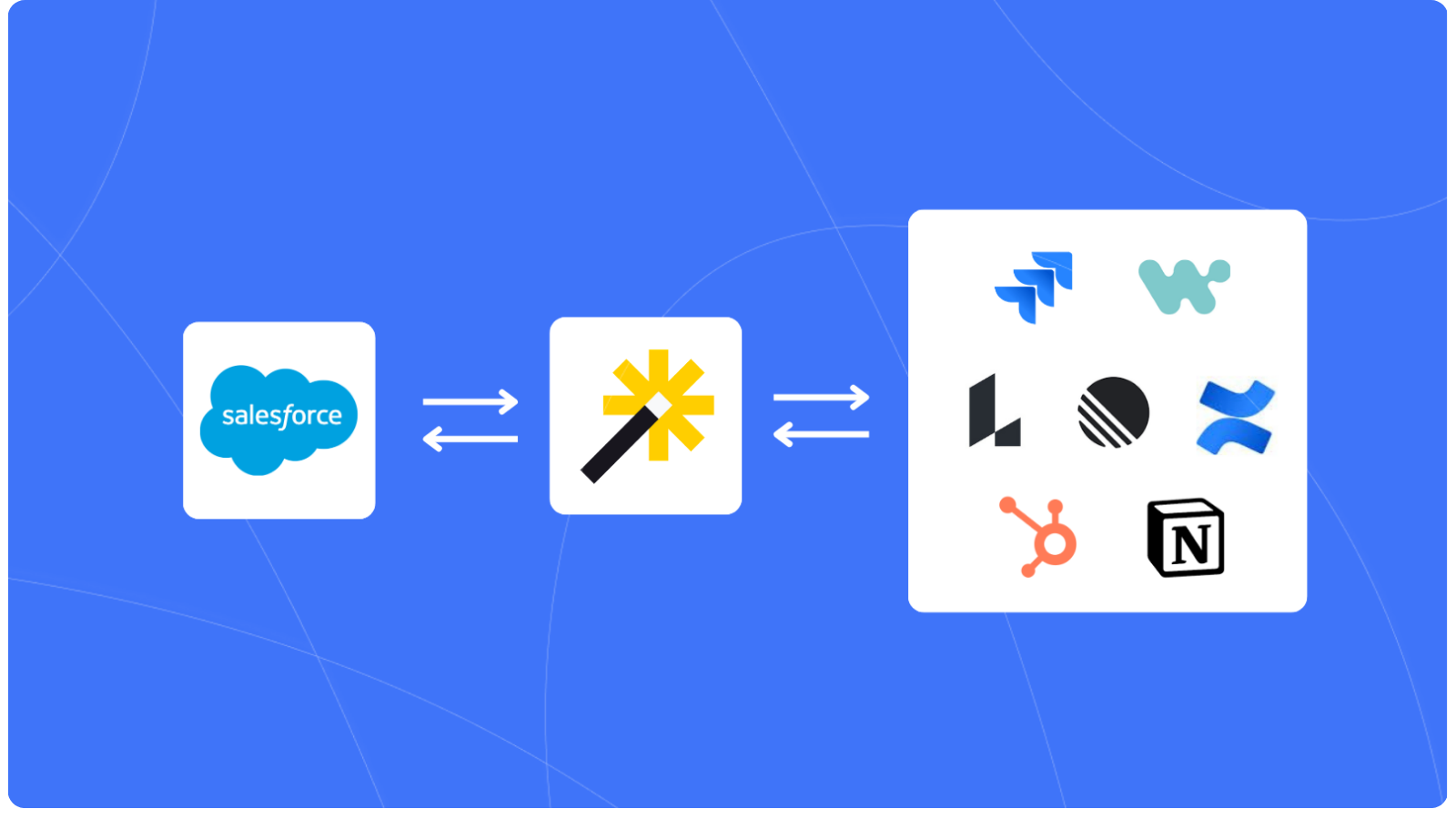
Sweep’s new MCP Client aims to solve that problem by extending Sweep into the rest of your stack through the open Model Context Protocol (MCP).
Until now, Sweep understood your Salesforce metadata. With MCP Client, the same agent can securely read from and act across Jira, Confluence, Linear, Notion, Lucid, Workato, HubSpot, and more.
The important shift here, as enterprise software already has plenty of integrations, is continuity: that is, instead of work stopping every time context crosses system boundaries, the same conversation can now move across the entire workflow.
A RevOps lead might start by asking Sweep to identify unused Opportunity fields. Sweep analyzes metadata relationships, downstream automations, validation rules, and dependencies inside Salesforce. Then, without leaving the conversation, the agent can create Jira tickets for the safest deprecation candidates, attach technical findings, and publish the audit into Confluence for stakeholder review.
The investigation, documentation, and execution planning happen together instead of across disconnected workflows.
That matters because most enterprise work today still revolves around reconstructing context.
AI dramatically accelerated build speed over the past year. Writing code, generating flows, and scaffolding automation now happens faster than ever.
But delivery timelines still stretch because execution rarely serves as the slowest part anymore.
The bottleneck has since moved upstream.
Teams spend enormous amounts of time figuring out:
That investigative work usually spans multiple disconnected tools.
Imagine a Salesforce admin trying to update an Account field tied to territory assignment logic. The field appears simple at first glance. Then someone remembers a Workato recipe touches it. Another teammate mentions an onboarding workflow documented in Notion. There’s an old architecture diagram in Lucid that might still matter. Meanwhile engineering already opened a Jira ticket asking why routing broke in staging.
Most organizations handle this through what you might call “human middleware.” Someone manually gathers screenshots, links, diagrams, tickets, Slack explanations, and tribal knowledge into one temporary mental model.
MCP Client reduces that reconstruction work by letting Sweep follow the context itself.
A user can ask:
“Trace everything connected to Account.Industry across Salesforce and Workato.”
Sweep can analyze the Salesforce metadata while also checking connected Workato recipes that depend on the same field.
Or a team might ask:
“There’s a Linear ticket assigned to me requesting a new approval flow. Pull the requirements and help design the implementation.”
Sweep can retrieve the ticket, combine those requirements with the organization’s metadata structure, and propose a system-aware architecture instead of generating isolated suggestions disconnected from the actual org.
The result feels less like jumping between apps and more like working inside a continuous operational layer.
One of the quieter problems inside enterprise operations teams involves documentation decay.
Teams document decisions constantly. But the connection between the documentation and the actual implementation often disappears almost immediately.
A Confluence page gets written during planning. Six months later, nobody knows whether the architecture still reflects reality. So, MCP Client helps close that loop.
Instead of documentation existing as a separate afterthought, the same workflow that generates analysis can also publish findings directly back into Confluence or Notion.
That means an audit doesn’t end as a transient chat conversation.
A user might ask Sweep:
“Publish this analysis to Confluence under the RevOps space.”
Or:
“Generate a Lucid diagram of this new Opportunity routing process and save the link into our Notion documentation page.”
Sweep can carry the output directly into the systems where teams already collaborate.
The practical impact here feels small until you compare it to how most organizations currently operate. Documentation often lags implementation by weeks because somebody has to manually recreate all the reasoning after the technical work finishes. This tool then compresses that gap.
The interesting thing about enterprise AI adoption right now is that capability no longer serves as the primary concern. Governance does.
Most organizations already know AI can accelerate work. The hesitation comes from uncertainty around permissions, oversight, and system access.
MCP Client approaches this with centralized administrative controls combined with user-level authentication.
Admins decide which connectors remain available organization-wide. Users authenticate using their own accounts rather than shared credentials. Permissions can stay granular, with separate controls for read-only versus write or delete actions.
Even within a single conversation, users can toggle which connectors remain active.
That structure matters because enterprise teams increasingly want agents that can actually do things — create tickets, publish documentation, generate diagrams, update systems — but without losing visibility into how those actions happen.
The future probably doesn’t belong to isolated AI copilots trapped inside individual applications.
It probably belongs to systems that can carry operational context across the full lifecycle of work.
That’s the direction MCP Client pushes Sweep toward: participating in the workflows surrounding your systems. They don’t operate in isolation, and neither should you.