Clean data. Faster revenue execution.
Sweep connects the systems behind your revenue engine — so you can understand how routing, automation, and data actually work, and fix what’s slowing your team down.
Why revenue operations break down
Revenue systems evolve constantly, accumulate automation layers, duplicate records, and inconsistent field usage. The issue isn’t just messy data — it’s operational infrastructure that no longer reflects how the business actually runs.
Duplicate records distort pipeline
Multiple versions of the same lead or account break ownership, inflate pipeline metrics, and create confusion across sales and marketing teams.
Routing and ownership drift over time
As territories evolve and headcount changes, routing logic often becomes fragmented across assignment rules, Flow logic, and external tools.
Operational logic becomes invisible
Automation layers determine how records are created, updated, and assigned — but tracing that logic requires digging through multiple systems.
How Ops and Analytics teams use Sweep
Sweep helps revenue operations teams run the operational systems that power pipeline, forecasting, and customer engagement.
Route leads and accounts with control
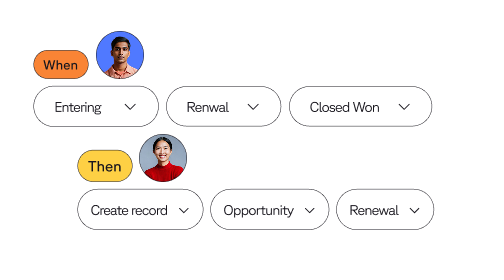
Lead routing often becomes fragile as territories evolve and assignment logic spreads across multiple rules and automation layers.
Sweep centralizes routing logic so RevOps teams can manage ownership and assignment from one operational workspace.
With Sweep, teams can:
- Route leads and accounts using territory, segment, or ownership logic
- Distribute assignments using round-robin or weighted balancing
- Ensure records reach the correct owner before entering pipeline
Eliminate duplicates before they reach pipeline
Duplicate records undermine forecasting accuracy, attribution, and sales ownership.
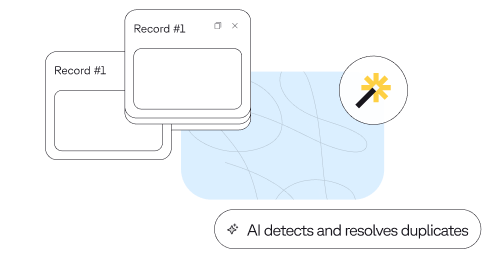
Sweep performs real-time deduplication inside Salesforce so duplicates are identified and resolved before entering operational workflows.
RevOps teams can:
- Detect duplicates across Leads, Contacts, and Accounts
- Automatically merge records using configurable rules
- Prevent duplicates from entering routing, reporting, and attribution systems
Trust the logic behind forecasting and pipeline
Revenue metrics depend on fields populated by automation, integrations, and operational workflows.
Sweep exposes how those fields are generated so teams can understand the logic behind forecasting and pipeline metrics.
This allows teams to:
- Trace how automation updates revenue fields
- Identify logic affecting pipeline or forecast calculations
- Align reporting definitions with operational system behavior
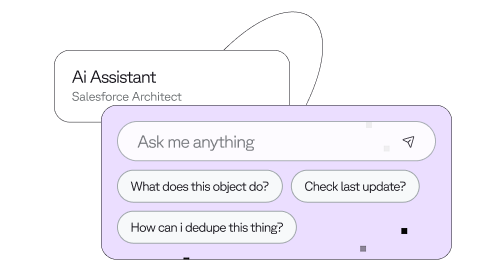
Trace revenue data across systems
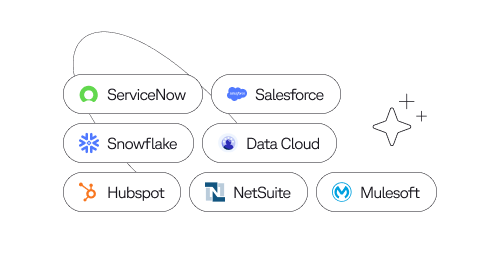
Revenue data rarely lives on one platform. It flows from Salesforce into data warehouses, BI tools, and analytics pipelines.
Sweep maps relationships across operational systems so teams can understand how data moves between platforms.
Teams can:
- See how Salesforce fields feed analytics and warehouse models
- Investigate discrepancies between operational and reporting data
- Understand upstream logic affecting analytics outputs
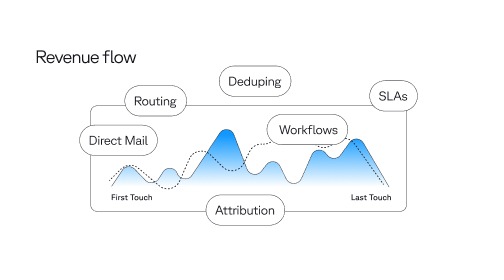
Automate revenue workflows without brittle logic
Revenue workflows often rely on layered Flow automation, triggers, and custom logic that become difficult to maintain.
Sweep provides a governed automation workspace for operational workflows.
RevOps teams can:
- Build triggers and conditions using visual logic
- Orchestrate workflows across multiple Salesforce objects
- Deploy automation safely from sandbox to production
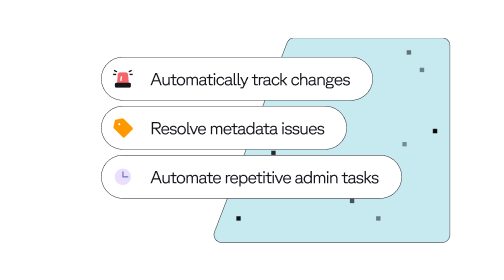
Prepare revenue systems for AI
AI initiatives depend on reliable operational data and system context.
Sweep exposes the relationships between automation, data models, and workflows so AI tools can operate with accurate system understanding.
Teams can:
- Ensure AI agents operate on trusted operational data
- Provide system context for automation and analytics models
- Prepare revenue systems for AI-driven workflows
How it works
Connect your system
Sweep indexes Salesforce metadata and operational logic into the Unified Metadata Graph.
Contextualize automatically
Routing rules, automation logic, and system dependencies are mapped into a connected model of operational data.
Reason with Agents
Teams and AI agents can analyze system behavior, trace data lineage, and automate operational workflows with full system context.
Customer stories

Challenge:
Cybrary inherited a complex LeanData routing architecture with hundreds of assignment rules and limited visibility into routing behavior.
Implementation:
Sweep centralized routing and embedded deduplication into the assignment process.
Results:
- Lead response time: 19.4 minutes → 33 seconds
- Routing deployed in one week
- 300% faster implementation
“Sweep’s UI made it clear what assignments were going where. Now iterating and making changes is much easier.”



Challenge:
Cognitiv discovered that 16% of Accounts were duplicates, which distorted reporting and sales ownership.
Implementation:
Sweep implemented real-time deduplication and operational alerts to enforce data integrity.
Results:
- 16% duplicate Accounts consolidated
- 20%+ increase in opportunity updates
- 5% reduction in days between sales stages
“Projects that would take a week across multiple stakeholders now take half a day.”



Challenge:
Esper relied on LeanData, Flow, and consultants to manage routing and automation.
Implementation:
Sweep consolidated routing and automation into one operational layer.
Results:
- 33% faster automation builds
- 63% reduction in project scoping time
- 25% cost reduction by replacing multiple operational tools
“Sweep lets a lean team adapt Salesforce to evolving GTM strategies without consultants.”


Ready to run revenue operations like infrastructure?
You don’t need more headcount to scale revenue. You need routing that holds, data that stays clean, automation that deploys safely, and systems your team can trust.
Sweep turns Salesforce into the operational engine behind your revenue systems.