

The finance software giant Brex runs one of the most sophisticated fintech operations in the world. But even the best Salesforce environments accumulate complexity over time…
When Dylan Hughes joined Brex as Business Systems Manager and Functional CRM Owner, he stepped into a Salesforce org that had evolved alongside a fast-growing company.
The system worked, but understanding it often required deep investigation across flows, validation rules, Apex classes, and legacy tickets.
Simple questions routinely turned into hours of backend analysis.
“We were spending hours, if not days, trying to track down who data owners were, why decisions were made, flipping through legacy tickets to understand state changes,” Hughes said.
That operational drag wasn’t just inconvenient. It was preventing the team from focusing on the strategic work Salesforce was meant to enable.
Instead of improving the platform, they were constantly untangling it.
Brex’s Salesforce instance sits at the center of its revenue operations and internal workflows. Like many rapidly scaling companies, the org had accumulated years of configuration decisions across teams and initiatives.
The team had a baseline understanding of the system, but key details about metadata relationships and automation behavior were often difficult to trace.
Basic requests from stakeholders could trigger lengthy investigation cycles.
“Even when we documented things, it became outdated quickly,” Hughes explained. “We were in a constant loop trying to understand what was happening at the field level, how flows were triggering, and what dependencies existed.”
The result was a growing operational burden.
“We were spending 20–30–40–50% of our weeks just trying to get above water,” he said.
Even worse, slow responses to simple questions began eroding stakeholder confidence.
“Trying to get answers to basic questions was eroding the trust battery.”
Once implemented, Sweep fundamentally changed how the team interacts with Salesforce metadata.
Hughes describes the experience with a simple phrase:
“Ask your metadata.”
Sweep immediately delivered two major advantages.
Sweep allows both new and experienced team members to quickly understand how Salesforce objects, fields, and automations interact.
“If someone is new to the org, they can chat with the agent to understand what to care about and how things work at a top level,” Hughes said.
For experienced team members investigating a specific issue, Sweep’s documentation agents provide deep system visibility.
“The documentation agents give a head start — field-specific, Apex-class-specific, validation-rule-specific — and that’s been an absolute multiplier for our efficiency.”
Instead of manually combing through flows or code, the team can immediately see field usage, dependencies, and automation triggers.
“Sweep was able to format this in one clean shot,” he added.
Sweep dramatically reduced the time required to answer operational questions inside Brex’s Salesforce environment.
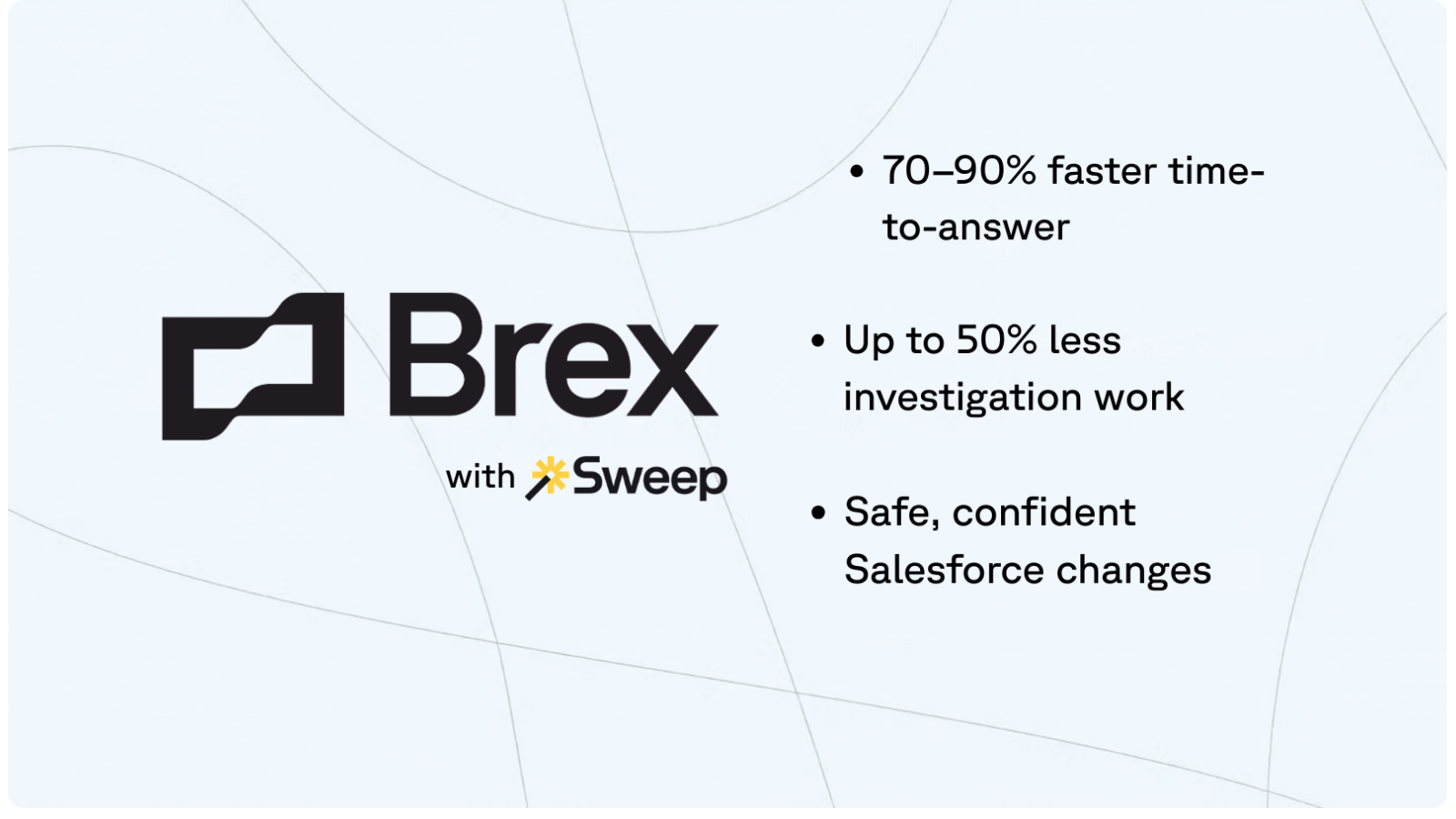
“We’ve been able to get answers to questions 70–90% faster—and I’d argue 90% is low in many cases,” Hughes said.
Before Sweep, answering a question often required a ticket, multiple admins or developers, and deep investigation into Salesforce configuration.
Now the team can often resolve the same questions instantly.
“With Sweep, we’re effectively able to get those answers with a few keystrokes—and produce very strong documentation.”
For Hughes, the biggest difference is BOTH the speed and the confidence.
“Before Sweep, getting a 30-second answer could take days,” he said.
“Sweep made cleanup safe,” he said. “and boosted confidence in every change.”