
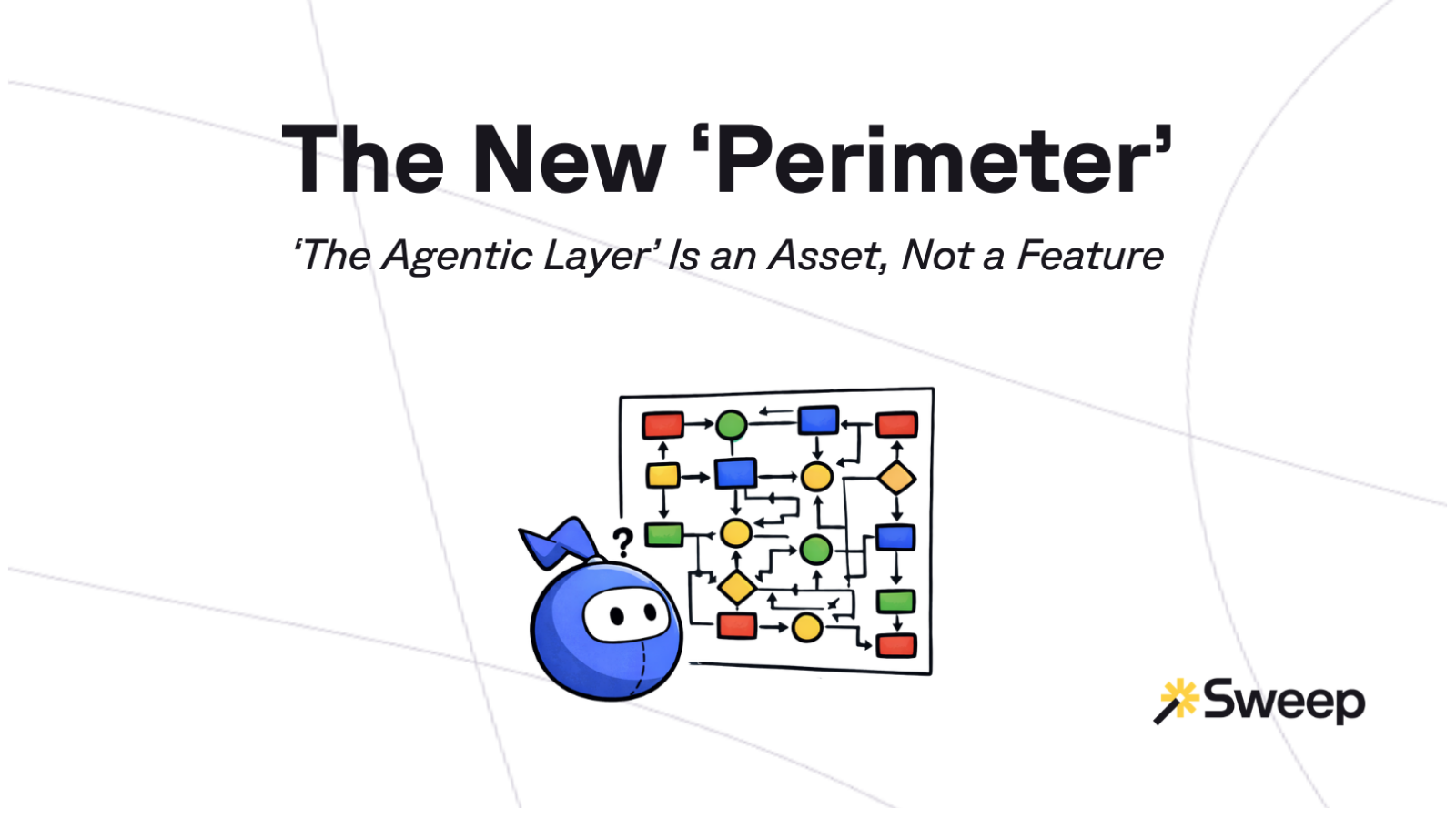
If you run enterprise systems — Salesforce, Snowflake, HubSpot, the whole stack — here's the message that should land in the next board meeting: The agentic layer for your systems is a new class of organizational asset.
Not a feature. Not a project. Not something you buy and deploy and move on.
It's yours. It will be built over time. You'll always have things to add to it. It's never complete. But it's an asset. One specific to your organization, constructed from your off-the-shelf systems and your bespoke configurations, that compounds in value the longer it runs.
And right now, most organizations are making a fundamental mistake: treating agents like a conglomeration of tools instead of infrastructure.
Security professionals understand this instinctively. Twenty years ago, "the perimeter" became a foundational organizational asset — not because anyone shipped a "perimeter" product, but because enterprises finally recognized that the boundary between inside and outside required continuous investment, continuous attention, continuous building.
The perimeter wasn't a firewall alone. It was a layer — one that accreted over time through policy, tooling, monitoring, and hard-won institutional knowledge about where the threats actually lived.
The agentic layer is the same kind of thing. Except instead of protecting the boundary, it captures how your organization actually works.
The industry is abuzz about "context graphs" right now — the idea that when agents execute workflows, they generate something valuable that enterprises have never systematically stored: decision traces.
What inputs were gathered across systems. What policy was evaluated. What exception route was invoked. Who approved. What state was written. And crucially: why it was allowed to happen.
Foundation Capital calls this "AI's trillion-dollar opportunity." Deloitte is still warning that most agentic pilots fail to reach production. Everyone's circling the same insight: the next platform shift isn't adding AI to existing systems of record — it's building systems of record for how decisions get made.
But here's what gets lost in the VC frameworks: someone has to build the layer that captures all this.
It doesn't materialize from model capabilities. It doesn't emerge from API calls. It requires infrastructure — specifically, infrastructure that understands your systems deeply enough to make agent execution meaningful.
When you treat the agentic layer as an asset, several things shift:
Ownership becomes clear. This isn't IT's problem or a vendor's deliverable. The CIO, the Head of Systems, the RevOps leader — whoever owns the operational infrastructure — owns this asset. It's as much theirs as the CRM or the data warehouse.
Time horizon extends. Assets appreciate. They require investment. You don't evaluate them on quarterly feature releases — you evaluate them on compounding capability. The question isn't "did this agent work?" It's "is the layer learning?"
The build vs. buy question inverts. You can buy tools. You can't buy your organization's decision traces. The layer has to be built, even if the components are off-the-shelf — because what makes it valuable is its specificity to you.
The "never complete" nature becomes a feature, not a bug. You'll always have new systems to connect, new workflows to capture, new edge cases to handle. That's not scope creep. That's the asset doing its job.
Consider the symptoms of an organization ignoring this:
Now consider the opposite:
The difference? You guessed it. It's the layer.
Here's where the industry discourse gets concrete: the way this layer actually builds up is through what some are calling a "context graph" — a living record of decision traces stitched across entities and time.
But a context graph doesn't build itself. It requires:
This is infrastructure work. It's not glamorous. It's not a demo. It's the difference between a toy and an asset.
If the agentic layer is an asset, then the investment model follows:
The organizations that recognize this now are building while others are still evaluating point solutions. They're not asking "which agent should we buy?" They're asking "how do we build the layer that makes all agents more effective?"
The mistake most organizations make is treating each AI initiative as a standalone project. Buy a tool. Deploy it. Measure ROI. Move on.
That framing misses the asset that's being built — or not built — underneath.
The agentic layer isn't Salesforce AI or Snowflake AI or whatever vendor slaps "AI" on their product. It's the infrastructure that sits across all of them, capturing how your organization actually makes decisions, and making that knowledge actionable.
CIOs and heads of systems: this is yours. Not a vendor's. Not IT's. Yours.
Build accordingly.