
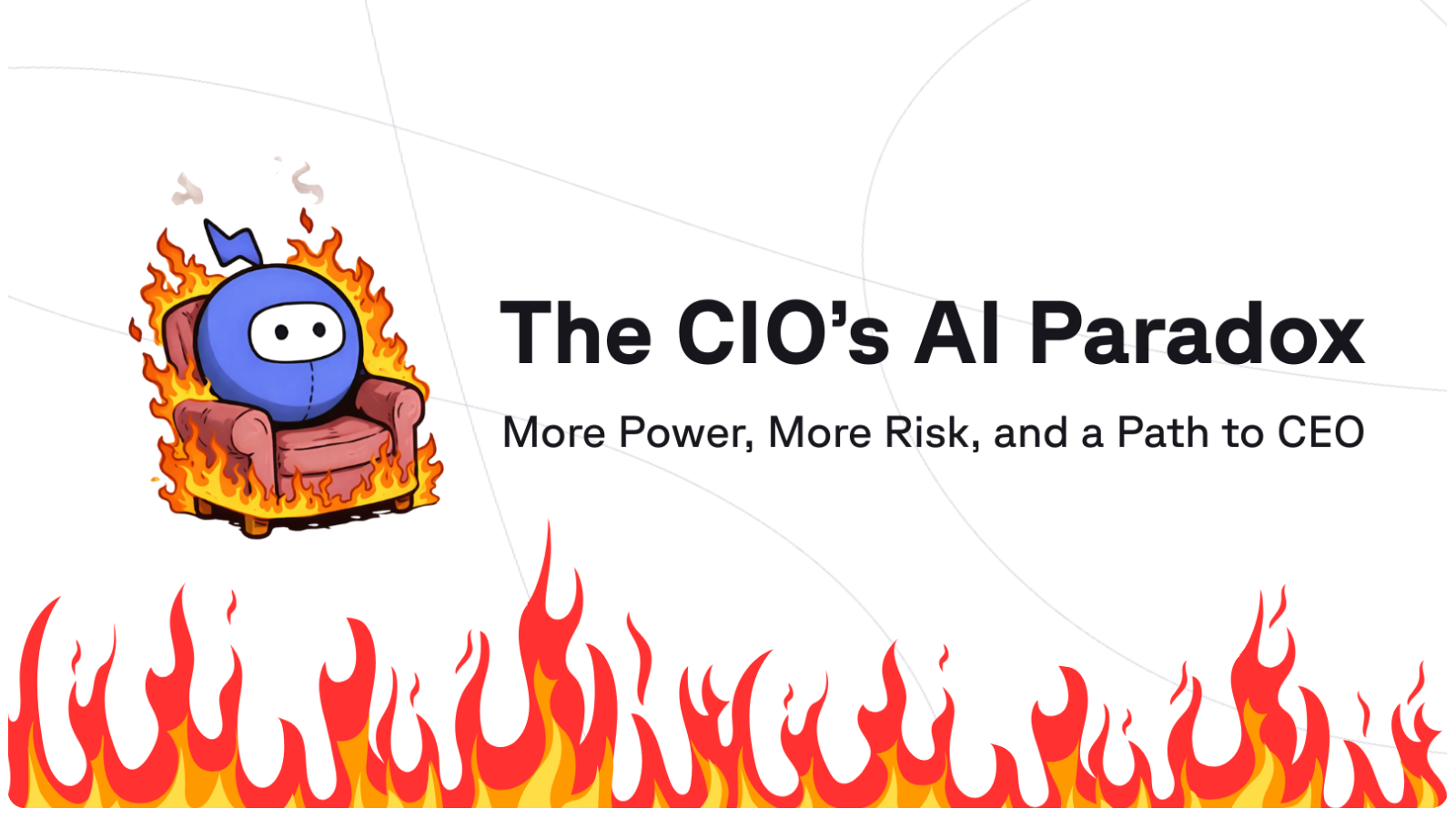
For years, the CIO fought for strategic relevance.
And then, that dog caught the car.
AI delivered on relevanacy, but the promotion came with a catch: the seat is much, much hotter than expected.
The data tells the story. A recent report by Deloitte shows that two-thirds of CIOs now report directly to the CEO.
This marks a structural shift in how companies create value. Technology has moved from a support function to the engine of growth, and the CIO now sits squarely at the controls.
And yet, influence hasn’t brought insulation. When AI initiatives stumble—when models hallucinate, data leaks, or costs spiral—the CIO is often the first to answer for it.
That tension between rising authority and rising exposure is the core of the CIO’s AI paradox.
On paper, today’s CIO is a strategist, architect, and growth leader. In reality, many are trapped.
They are accountable for the performance, security, and governance of AI systems that are frequently selected and deployed by other departments. Marketing rolls out one tool. Sales pilots another. Ops experiments with a third.
When something breaks, it all rolls uphill to IT.
This is most definitely the most dangerous part of the paradox: accountability outpacing authority.
Call it the perfect storm — sky-high expectations, low organizational readiness, and decisions made in disconnected silos. The CIO is stuck in the middle, responsible for outcomes without full control over inputs.
The challenge extends beyond the organizational. It’s financial, technical, and even geopolitical — all at the same time.
We’ve officially moved out of the AI hype phase and into the ROI reality check.
CFOs are no longer asking what AI could do; they’re asking what it’s doing for the business right now.
Forrester predicts that 25% of planned enterprise AI spend will be delayed until 2027 because the returns are too unclear.
And yet, another paradox: spending isn’t slowing down.
Gartner estimates AI investment is still growing at more than 35% annually.
CIOs are being asked to spend more money while proving value with greater precision and less margin for error.
On top of that, agentic AI is arriving fast.
These systems can act autonomously to achieve goals, raising both the promise and the risk. Gartner expects 40% of agentic AI projects to fail by 2027. F
or CIOs already in the hot seat, that’s another layer of exposure.
Geopolitics adds even more complexity. Half of CIOs outside the U.S. expect to change vendor strategies due to regional pressures, compared to just 31% in the U.S. One-size-fits-all tech strategies no longer work in a fragmented world.
Several forces are converging to make this moment uniquely difficult for CIOs:
None of these issues live purely in IT — but they all land there when something goes wrong.
Getting burned isn’t inevitable. The CIOs navigating this moment most successfully are literally rewriting the rules of leadership.
They are reclaiming authority over core technology decisions, shifting focus from scattered pilots to durable enterprise foundations, and reframing AI leadership as a shared responsibility across the C-suite rather than a solo burden.
That foundation work isn’t about buying more servers. It’s about architecture, clean and consistent data, clear governance, and guardrails that let the business innovate safely.
The smartest CIOs are prioritizing:
Weak foundations make every failure look like an IT failure — even when it isn’t.
Here’s the biggest twist of all: this pressure cooker may be the best leadership training ground in the enterprise.
Balancing innovation with risk, translating complex systems into business outcomes, and leading change across silos are exactly the skills modern CEOs need. CIOs know it. Deloitte found that 67% of CIOs aspire to become CEO — more than any other tech executive role.
Their peers agree. When executives are asked why CIOs are suited for the top job, they point to their ability to drive growth, lead through complexity, and build high-performing teams.
AI may have turned the CIO’s seat at the table into a high-pressure crucible. But that same pressure could be forging the next generation of CEOs.
The paradox is that the CIO’s greatest challenge may indeed be the greatest opportunity of all.