

Rebuy Engine’s Revenue Operations team was losing over 20 hours a week to Salesforce troubleshooting, manual reporting, and support tickets. Sweep’s agentic workspace for Salesforce turned that operational drag into automated diagnostics, self-serve reporting, and proactive system monitoring. Here's how they got their time back.
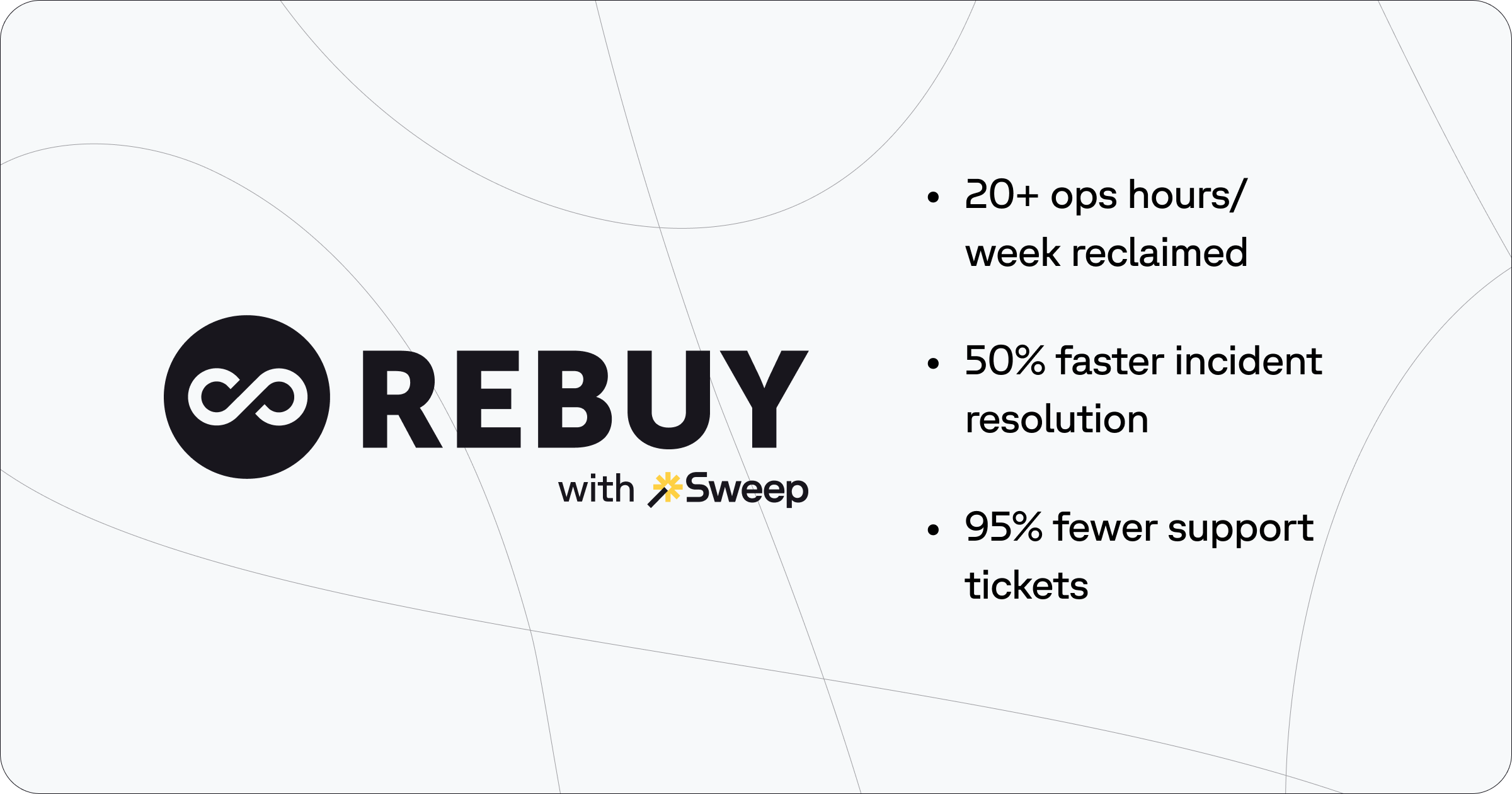
Key results:
Rebuy Engine helps thousands of e-commerce brands personalize at scale. That level of personalization requires a Salesforce and Go-to-Market (GTM) systems ecosystem that can support high-volume data, constant automation, and rapid process iteration. As the company grew, so did the operational load, impacting reporting, forecasting, customer workflows, and cross-functional decision-making.
Overseeing this environment is Nicole Looker, Director of RevOps, responsible for Salesforce architecture, Data Cloud integrations, automation, reporting, and GTM systems across eight departments.
Salesforce sits at the center of Rebuy’s operations. As Nicole puts it: “Salesforce is the core of everything for our go-to-market teams.”
The org processes data from BigQuery into Data Cloud, triggers automations, and drives alerts and workflows across Sales, CS, and Partnerships — all amplified by Sweep as their automation and visibility layer.
As Nicole described, “We have a lot of data points coming into Salesforce from different areas. We’re troubleshooting a lot of different things, with a lot of different fields, and all of that can get cumbersome over time. We have a lot of things in flight at one time. It’s definitely chaotic, and we had some complex processes that we needed to properly map out and redesign.”
This operational drag didn’t just slow the team; it pulled attention away from architecture, governance, and the GTM roadmap.
During what was meant to be a standard Sweep demo, a critical Salesforce issue emerged: following their Data Cloud implementation, all Closed Won opportunities were overwritten with today’s date, corrupting forecasts and revenue reporting.
“Something updated a bunch of records… it changed already closed won opportunities’ close dates. It was messing up our pipeline and old revenue reporting. We had no idea what was causing it.
Preparing to cancel, Nicole mentioned the issue. Sweep offered to investigate live.
“Sweep found it in about two minutes, and we fixed it within about 15 minutes by diving into the automation nodes. That would have taken me an entire day to figure out, while it kept running and updating more things. Solving it that quickly was mind-boggling.”
A full-day firefight instantly collapsed into a 2-minute root cause and 15-minute resolution. That moment reframed what Salesforce operations could look like when systems document and explain themselves.
Rebuy implemented Sweep as an intelligent operations layer on top of Salesforce: documenting processes, monitoring architecture, powering support, and enabling natural-language access to data.
For Nicole, AI-powered documentation for Salesforce is the foundation:
“The AI-powered documentation is the fundamental thing that sets Sweep apart from other tooling. Every time I talk to other Salesforce people, their minds are blown. Being able to troubleshoot and see that stuff so quickly is like adding an extra half person to my team. What would have taken one or two days now takes about 15 minutes.”
The Documentation Agents extend that further, especially for junior team members:
“The AI agents take the documentation a step further. My team member is more junior, so she might not know which object to go to or what a field is called. With the agentic piece, she can just say, ‘This field is causing these issues, do you know why?’ and talk to it. It has streamlined her processes and helped her get up to speed faster.”
Nicole inherited significant tech debt. Sweep’s architecture agents surfaced issues instantly and provided precise fix instructions.
“The Monitoring Agents tell you everything that’s bad about your setup. They say, ‘These flows need this fixed, here’s why, and here’s exactly how to do it.’ Normally you’d need a Salesforce architect or I’d sit for hours figuring it out. Now we have a checklist.”
This eliminated hours of manual investigation and aligned the org to best practices while allowing custom business rules where needed.
Looking ahead, Nicole sees Sweep’s AI-powered process visualization as key to planning:
“Our processes have gotten complicated over the past few years. Sweep helps us map them out so we can see what’s happening, what’s flowing through the pipeline stages, what’s working, what’s not, and where we can be better. Having a tool that can see all your metadata, do it for you, and visualize it is so powerful, instead of doing that manually, which is very time-consuming.”
Rebuy deployed Sweep’s Support Agent so end users can self-diagnose errors and field questions.
“We love the Support Agent. It has taken down the number of direct messages I get for ‘What does this field mean?’ or ‘I’m getting this error message.’ Now teams can copy and paste the validation rule error and it tells them what they need to do, or they go there with field questions instead of coming to us. The Support Agent is so easy to implement. It takes five minutes to turn it on. I made a quick Loom video, and everybody’s off to the races.”
DMs dropped from 4–5 per week to about one per month, a direct, measurable relief on systems resources.
Sweep’s Model Context Protocol (MCP) changed how leadership and RevOps interact with Salesforce data.
“My go-to-market leaders love it, because instead of coming to me for random questions, they can ask questions about our Salesforce data directly.”
When the COO asked for 12-month AE retention rates, a report requiring multiple systems, datasets, and hours, Nicole simply asked MCP and it generated a full retention scorecard instantly.
“We trained our team leads on how to ask questions, get lists pulled, and get quick data points for meetings. It’s been fantastic.”
Rebuy migrated Slack alerts from Momentum.io to Sweep Alerts, consolidating systems and enabling revenue alerts around upsell signals, feature-install cross-sell triggers, high-value billing for annualization, renewal timelines, partner updates.
Now alerts power sales, CS, and partner workflows:
“We use Alerts for close-won and close-lost deals, important demos, and to notify CS when a customer has a bill over $1,000 so they can move them to an annual agreement. We also surface product-usage signals to our cross-sell team and track annual renewals with timed alerts leading up to the due date.”
Sweep returned 20+ hours of weekly system capacity, equivalent to 0.5 FTE, by eliminating manual troubleshooting, ad hoc analysis, and support load.
| Area | Measured Impact |
|---|---|
| Incident resolution | 50% faster; major issue fixed in minutes instead of a full day |
| Troubleshooting & investigations | 10–12 hours/week reclaimed |
| Reporting time | Reporting reduced from 1 hour → 20 minutes |
| Reporting requests | 5–8 weekly requests now self-served |
| End-user support | Support tickets reduced by 95% |
| Total weekly time savings | 20+ hours/week returned |
Sweep didn’t just make Rebuy’s RevOps team more efficient. It transformed how the entire organization interacts with Salesforce.
Nicole sees Sweep as the new standard for modern Salesforce operations: clarity through documentation, stability through monitoring, efficiency through self-service, and acceleration through automation.