

TL;DR:
Most enterprise Salesforce environments aren't a single, clean instance. They're a collection of orgs that accumulated over time through acquisitions, regional expansions, business unit autonomy, and the best intentions of teams who just needed to get things done.
Today, Sweep is launching Multi-Org Mode, the first Salesforce multi-org platform that provides the ability to connect multiple Salesforce orgs to Sweep’s Agentic Layer, and analyze, compare, and document them all from one conversation with the Metadata Agent.
74% of enterprises running Salesforce across multiple regions report significant challenges due to siloed data. Large enterprises commonly operate between 3 and 15+ Salesforce orgs.
They arrive via:
Each org made sense in isolation. Together, they create a fragmentation problem that compounds every year you leave it unaddressed and no multiple Salesforce orgs management software had previously existed to surface it all at once.
The costs of Salesforce multi-org setup sprawl are real, but they're distributed in ways that make them easy to ignore until they aren't.
Operationally, every enhancement gets deployed twice (or four times). Every security patch gets applied in sequence across instances. Every new admin has to learn multiple environments. The same automation logic lives in three orgs, maintained by three different people, drifting apart with every release cycle. Without a proper Salesforce multi-org governance tool, this drift is invisible until it breaks something.
Commercially, your revenue teams are flying blind. A customer relationship that spans two business units looks like two unrelated customers. White space analysis is impossible when the data required to run it lives in a different org. Cross-sell and upsell opportunities that would be obvious in a unified view are simply invisible.
Research consistently puts the average annual revenue left uncaptured due to data fragmentation at over $3 million, and that's a conservative estimate for large enterprises. The lack of a Salesforce Multi-Org alignment platform is a silent revenue drain most CFOs haven't yet quantified.
And now fragmentation is now an AI problem. And that's where the stakes get serious.
Salesforce Agentforce has changed the conversation about data quality from "important" to "urgent." AI agents are context-dependent systems. Their intelligence, accuracy, and trustworthiness are a direct reflection of the data and metadata they can access.
But in a fragmented environment, that context is broken.
An agent operating inside your North American org can't see the service escalation sitting in your EMEA org. It can't see the account history from the company you acquired two years ago. It recommends a promotional offer to a customer who's been trying to cancel for three weeks… because it genuinely doesn't know.
This results in AI agents that sound confident but miss crucial context. Teams stop trusting recommendations. The ROI on your Agentforce investment quietly evaporates. The data is unambiguous on this: organizations implementing data-first AI solutions achieve an 87% deployment success rate. Those deploying AI on fragmented, unprepared data? 23%. This is the difference between AI transformation and wasted investment.
Multi-org fragmentation isn't just a housekeeping problem. It's the single biggest hidden blocker to AI adoption in the enterprise.
Until now, analyzing a multi-org environment meant logging in and out of instances, running separate reports, exporting metadata, and reconciling everything in a spreadsheet. It was slow, error-prone, and always out of date before it was finished.
Multi-Org Mode changes that.
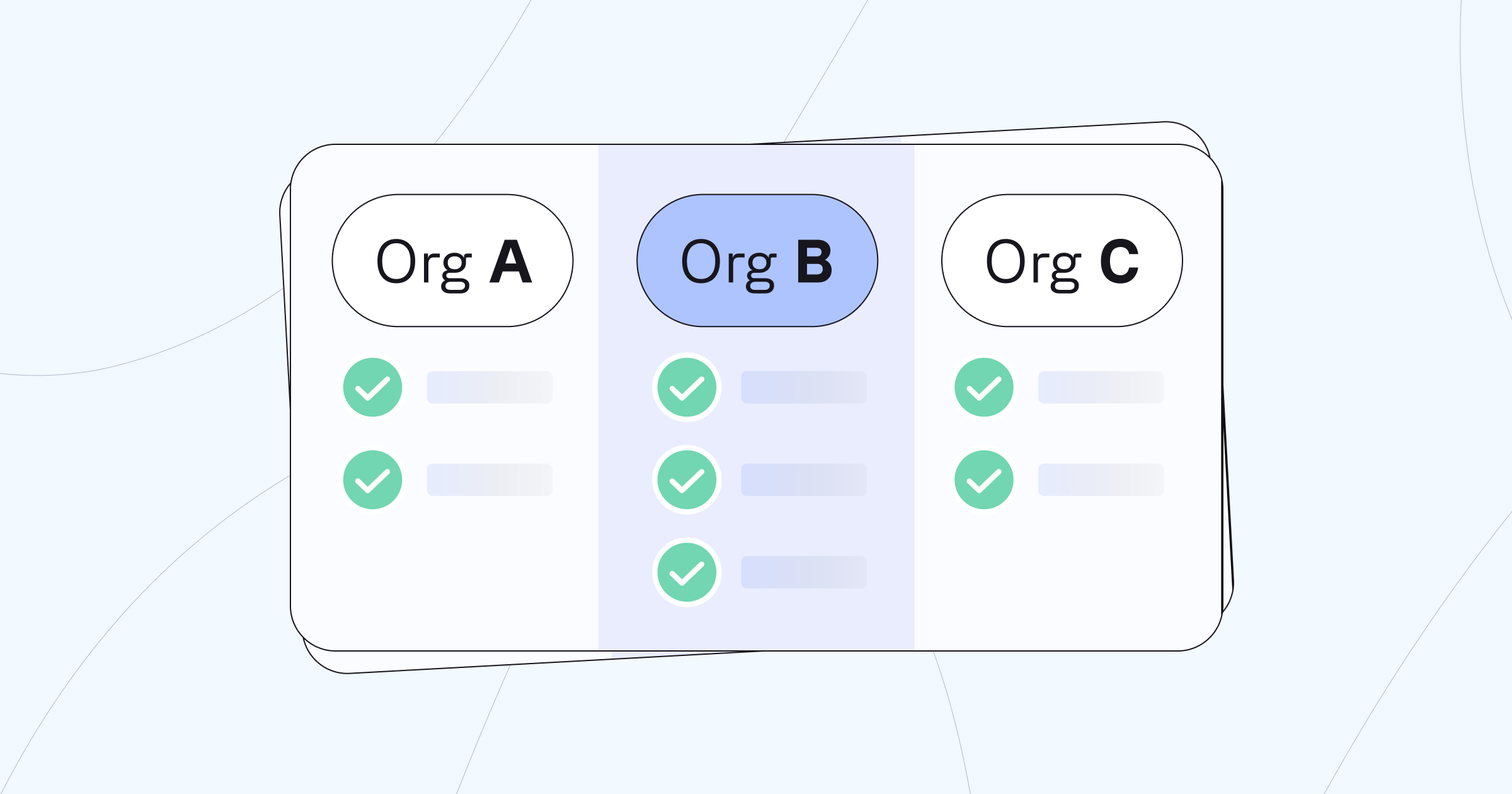
Now you can connect your Salesforce orgs to Sweep’s Agentic Layer and ask questions like "Compare the Opportunity object across Org A and Org B."
Sweep's Metadata Agents pulls the full configuration from both orgs and surfaces the differences, field by field, automation by automation.
"Which custom fields exist in the acquired org but not in ours?" Instant gap analysis. No manual comparison. This is Salesforce org consolidation software working at the speed of a conversation.
"What's different about the Case object between sandbox and production?" Configuration drift caught before it becomes a deployment failure.
"Which org has the most technical debt on Account?" The agent analyzes complexity, unused fields, and automation count across every connected instance.
Every answer is grounded in your actual system metadata.
Post-acquisition Salesforce integration is one of the most expensive and time-consuming IT challenges in the enterprise. The traditional approach involving manual discovery, stakeholder interviews, configuration exports, weeks of consultant time before any integration planning can begin, is broken.
With Multi-Org Mode, an acquiring organization can connect both Salesforce environments and begin meaningful analysis within hours. Which objects overlap? Where do field definitions conflict? What automation logic exists in the acquired org that doesn't exist in ours? What dependencies would constrain migration sequencing?
Weeks of discovery work compressed into a conversation to expedite merging Salesforce orgs. Gap analysis that's accurate before migration planning begins, not halfway through it. For companies actively managing M&A integration, this alone justifies the investment.
If you're managing more than one Salesforce org, whether that's a production and sandbox, a post-acquisition environment, or a global Salesforce multi-org setup, this is the fastest way to understand what you actually have. To learn more about Multi-Org Mode click here or book a demo to see it in action.