
TL;DR
Every Salesforce change sends ripples through an interconnected web of metadata, automation, integrations, and business processes.
Teams that ship without understanding those ripples aren’t just taking technical risks, they’re undermining trust in the system itself.
That risk is escalating.
Agentforce and AI agents now depend on clean, well-described metadata to reason correctly. Downstream impact analysis has moved from “good admin hygiene” to strategic infrastructure. If your metadata is unclear, undocumented, or tightly coupled in ways no one remembers, AI will amplify the problem— not fix it.
The failure rates tell the story. Most transformation initiatives fail because of change management, not the underly technology. Gartner now predicts that a majority of AI projects will be abandoned due to poor data readiness. The common thread here is the inability to understand how systems actually behave when changed.
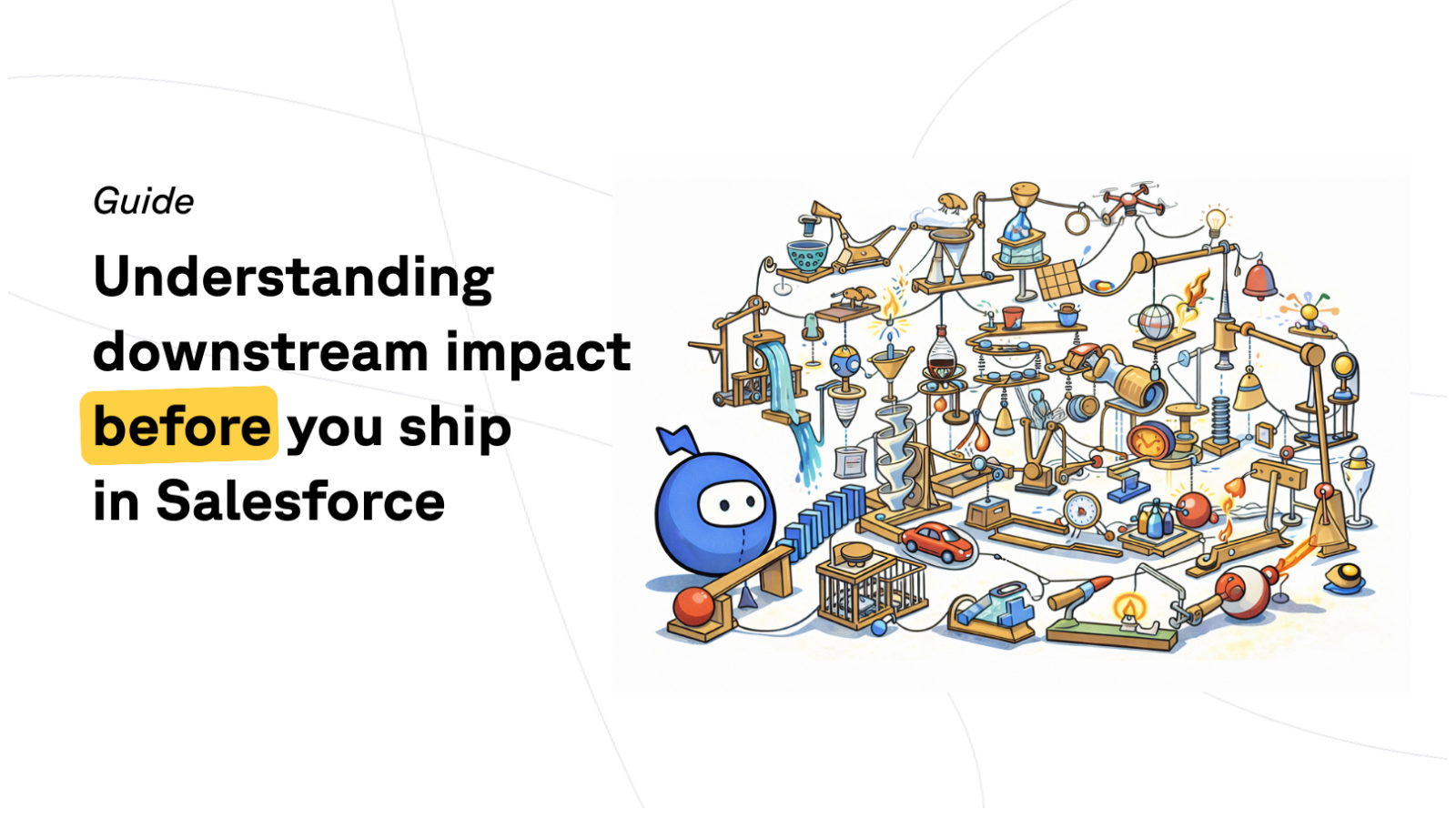
Salesforce looks modular on the surface. Underneath, it behaves like a dense dependency graph.
Fields are referenced by flows, formulas, Apex, reports, dashboards, list views, integrations, and external systems. Automations fire in strict sequences that create cascading side effects. Security changes ripple through profiles, permission sets, sharing rules, and APIs simultaneously.
Salesforce gives you partial visibility into this web, but never the full picture. Native tools show fragments of usage, often in one direction, and often excluding the places where breakage hurts most — reports, dashboards, integrations, and analytics.
The most dangerous dependencies are the invisible ones. External systems bind to API names, not labels.
A "simple cleanup" can silently break integrations. Report failures often surface weeks later, when leadership questions the numbers. Automation loops consume governor limits long before anyone traces the root cause.
This is how organizations end up with a culture of fear: “Don’t touch that field.”
When Salesforce changes break workflows, users adapt — just not in the way you want.
Mostly, they stop trusting the system. They keep shadow spreadsheets. They delay updates until “later.” Over time, Salesforce stops being the system of record and becomes a system of partial truth. Forecasting shifts to offline files. Sales, marketing, and finance disagree on numbers. Leadership believes alignment exists; frontline teams know it doesn’t.
These failures rarely look dramatic at first.
They show up as small frictions: approvals slowing down, reports feeling “off,” data entry becoming performative. But the compound effect is severe. Revenue planning weakens. Compliance gaps widen. Institutional knowledge lives in people’s heads instead of the system.
Downstream impact analysis isn’t about preventing every mistake. It’s about preventing silent erosion.
Traditional automation assumes humans hold context and systems execute instructions. Agentforce flips that model. AI agents must infer intent, select actions, and reason about outcomes using metadata as their map of reality.
Names, descriptions, field definitions, and flow labels aren’t cosmetic anymore. They’re how agents decide what to do.
An undocumented flow is invisible to AI. A poorly named field is semantically misleading. A tightly coupled automation chain becomes a minefield when agents operate at machine speed. The better your metadata describes reality, the better your agents behave. The worse it is, the more confidently they make the wrong decision.
This is why AI readiness is really metadata readiness.
Teams that ship safely don’t rely on heroics. They rely on discipline.
Before deploying, they understand what a change touches—not just technically, but operationally. They test in environments that resemble production. They know which changes are reversible and which are destructive. They document intent, not just configuration.
Most importantly, they treat metadata as infrastructure. Something that deserves clarity, ownership, and ongoing care.
Governance doesn’t slow these teams down. It gives them leverage. When dependencies are visible and documented, change becomes routine instead of risky. Velocity comes from confidence, not caution.
Salesforce doesn’t fail because it’s powerful. It fails when its complexity is unmanaged.
In an AI-driven world, downstream iimpact analysis is no longer optional. Every undocumented dependency, every brittle automation, every ambiguous field definition increases system drag and limits what AI can safely do.
The organizations that succeed won’t be the ones that add the most AI features. They’ll be the ones with the least metadata chaos.
Clean systems invite intelligent automation.
Messy systems repel it.
The real question isn’t whether you can afford to invest in understanding downstream impact before you ship. It’s whether you can afford to keep shipping without it.