
TL;DR: Salesforce’s latest admin certification update quietly reframes AI as a governance issue. If your system isn’t understandable, permissioned, and predictable, AI only becomes a risk multiplier.
For a long time, AI in Salesforce has been treated like an add-on.
Something you enable. Something you pilot. Something you layer on top of an existing system and hope behaves itself.
That framing is starting to crack up before our very eyes.
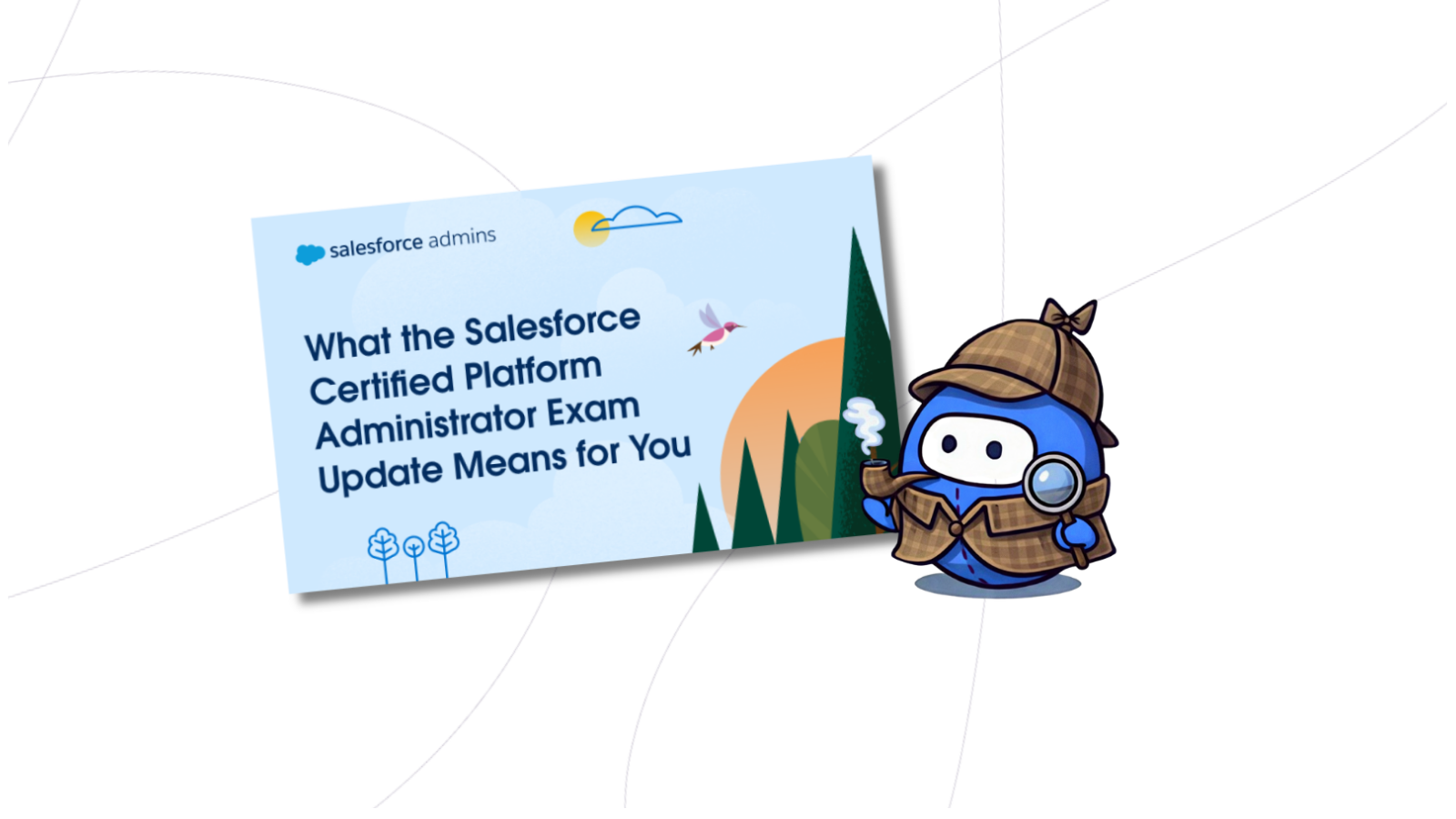
In January 2026, Salesforce updated its Salesforce Certified Platform Administrator exam. On paper, it looked like a normal refresh: some weighting changes, a bit more emphasis on analytics, a little 8% nod to AI.
But if you look closely at what actually changed, the message is sharper —and more consequential — than it appears.
The wild catch here: Salesforce didn’t just add AI to the exam... they actually made AI conditional.
Conditional, that is, on whether your system is understandable. Conditional on whether permissions are sane. Conditional on whether automation, data, and object relationships actually make sense together.
In other words: AI is now downstream of governance.
This isn’t spelled out explicitly, but it’s encoded everywhere in the updated blueprint. Core admin domains like data modeling, automation, permissions, and security all carry more weight. And for the first time, Agentforce appears as a first-class topic.
This is Salesforce's way of formalizing something many systems teams have already learned the hard way: AI doesn’t fix messy systems. It amplifies them, at scale.
What’s interesting about the new Agentforce section is what it doesn’t focus on. There’s very little emphasis on clever prompts or advanced AI choreography. Instead, the exam leans into questions that sound almost… conservative.
This isn’t about innovation theater. It’s about preventing AI from doing something you didn’t intend.
That extends beyond "AI problem" to governance problem.
Salesforce is implicitly acknowledging that agents inherit the shape of the systems they operate in. If your metadata is coherent, AI scales that coherence. If your system is held together by tribal knowledge and “please don’t touch that field” warnings, AI just accelerates the damage.
And that leads to the uncomfortable truth hiding inside this exam update.
If your team can’t confidently explain what happens when a field changes…
If no one can trace how automation ripples downstream across objects and tools… If permissions, dependencies, and data lineage only exist in people’s heads…
Then AI makes your org faster at being wrong.
Salesforce isn’t being pessimistic here. If anything, it’s being unusually honest.
AI readiness isn’t a model problem.
It isn’t a tooling problem.
It isn’t even a talent problem.
It’s a systems visibility problem.
You can’t govern what you can’t see.
You can’t automate what you don’t understand.
And you can’t safely deploy AI inside a system that’s opaque to the people responsible for it.
The certification update doesn’t solve that. But it does something just as important: it validates the reality systems leaders are already living in. Admins are no longer being trained to “support AI.” They’re being trained to think in dependencies, data flows, permissions, and downstream impact—because that’s where AI either succeeds or fails.
The gap now is obvious. Memorizing those relationships for an exam is one thing. Being able to see them clearly, continuously, and across systems is another.
That’s the real shift underway.
Salesforce has redefined what “AI-ready” actually means.
And it starts with knowing what happens next.