
TL;DR:
Over the years, data governance has gotten very good at answering one question: Where did all of this data come from?
It has decidedly gotten much worse at answering the question that actually breaks systems: Why did all of this happen?
For instance: Why did a deal reroute itself halfway through the quarter? Or, Why did a forecast swing overnight with no obvious data change? Or even, "Why did an AI agent do something confidently — and catastrophically — wrong?"
When teams go looking for answers, they usually start with the usual suspects: data. Tables, fields, dashboards, pipelines. And yet, they usually come up empty.
This is because the answer almost never lives in the data alone. It lives in the logic wrapped around it.
That’s the gap logic lineage exists to name — and to finally close, once and for good.
Traditional data lineage is more about movement than anything else...
A record travels from a source system through transformations and into reports or perhaps a field is populated, enriched, synced, and eventually used in a decision. This variety of visibility is still vital. And yet, it’s still not enough.
Modern systems don’t just move data from point A to B. They interpret it. They apply conditions, trigger automations, enforce constraints, and decide what happens next.
Those decisions still don’t live in schemas. Logic is their home.
Routing rules decide ownership. Validation rules decide whether change is allowed. Automations decide which downstream systems react — and in what order.
Data lineage can tell you what flowed. It most certainly can’t tell you what acted.
Lineage without logic is a map without traffic laws.
Whether it’s documented or not, every company runs on logic,
Some of it is explicit and intentional. Someone once wrote: “If ARR is greater than $50k, route to Enterprise.” Someone defined what happens when a stage changes. Someone enforced a rule to block approvals under certain conditions.
But much of it is totally accidental:
This logic layer determines outcomes across sales, finance, support, and product. And yet it’s almost never understood, let alone governed, as a system.
When something breaks, teams investigate symptoms.They rarely have visibility into causes.
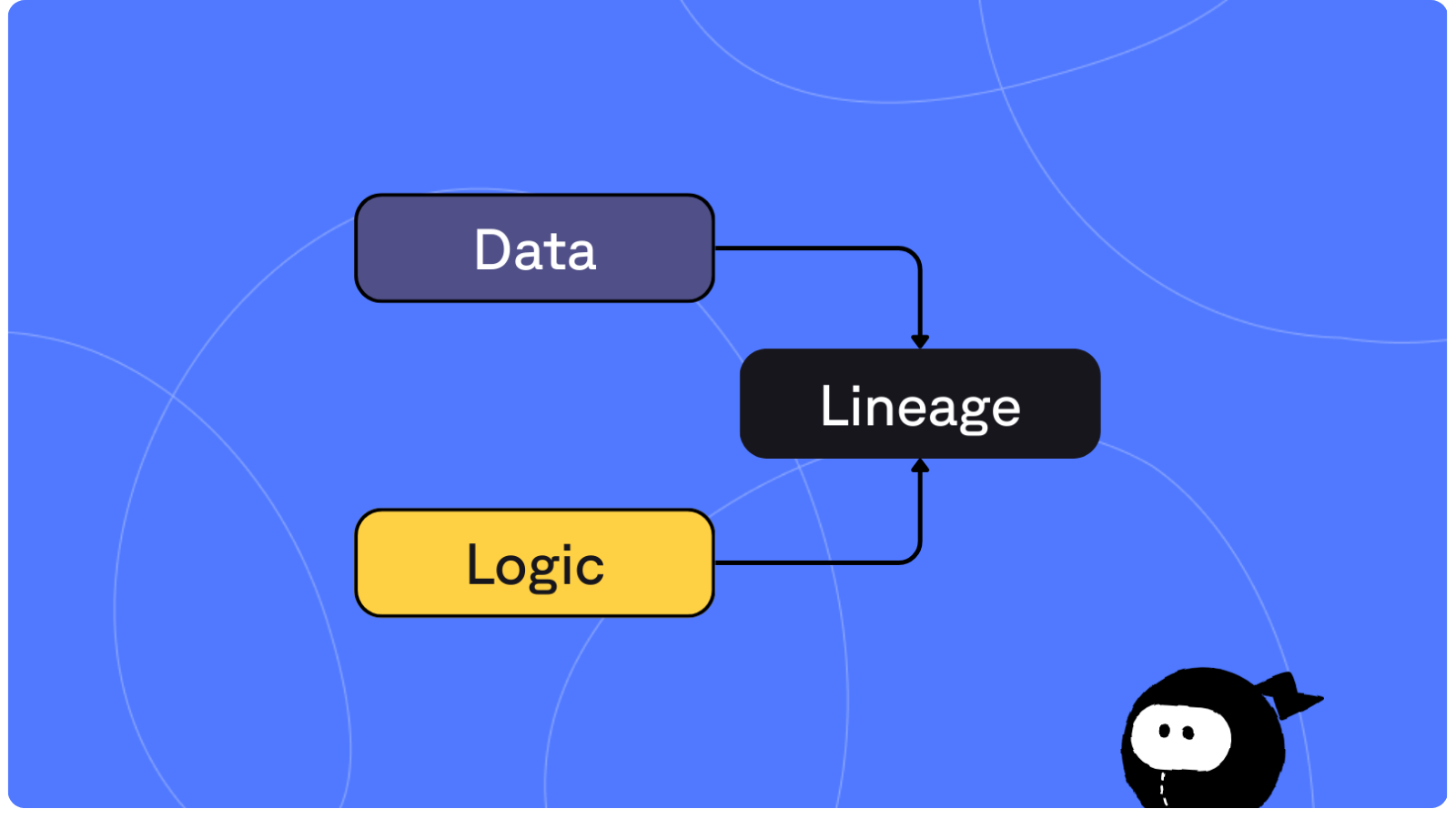
Logic lineage is the practice of tracing, documenting, and governing how business logic influences data behavior across systems. Instead of asking only where did this data go, logic lineage asks:
In other words:
Data lineage shows flow. Logic lineage shows causality.
This distinction matters deeply because causality is what allows systems to be governed, changed safely, and reasoned about — by humans and by machines.
Obviously, this concept isn't new. What’s new is how unavoidable it has become.
Systems are more interconnected than ever. A small logic change in one place can reshape behavior across CRM, billing, forecasting, and analytics — often without anyone realizing it.
At the same time, AI is no longer just reading data. It’s acting on assumptions encoded in metadata and logic. Agents reason from definitions, constraints, and decision paths, not raw numbers alone.
When that logic is inconsistent, AI fails with supreme confidence.
And finally, teams are moving faster than their visibility. Shipping without understanding logic impact isn’t agility. It’s a business version of Russian roulette.
Traditional governance focuses on structure: Who owns the data. What the schema looks like. Who can access which fields. Whether compliance boxes are checked.
Logic lineage adds behavior to the mix.
It introduces dependency awareness, makes change impact understandable before deployment and turns governance from a static checklist into a living model of how your system actually works.
Without this layer, governance becomes paperwork. With it, governance becomes infrastructure.
Static documentation decays. Tribal knowledge fritters away. Logic lineage only works when it’s continuously updated, system-aware, and tied to real operational behavior — not diagrams frozen in time.
This is the shift from describing systems to understanding them.
At Sweep, logic lineage is operational metadata in motion, a continuously updated understanding of what logic exists, where it runs, what it affects, and how it changes over time.
This is what enables safer AI agents. Faster system changes. Governance that actually scales.
Because you can’t govern what you can’t see. And you can’t trust systems you don’t understand.
Logic lineage is the missing half of data governance, and the secret unlock that moves teams from the past, onward, into the future.