
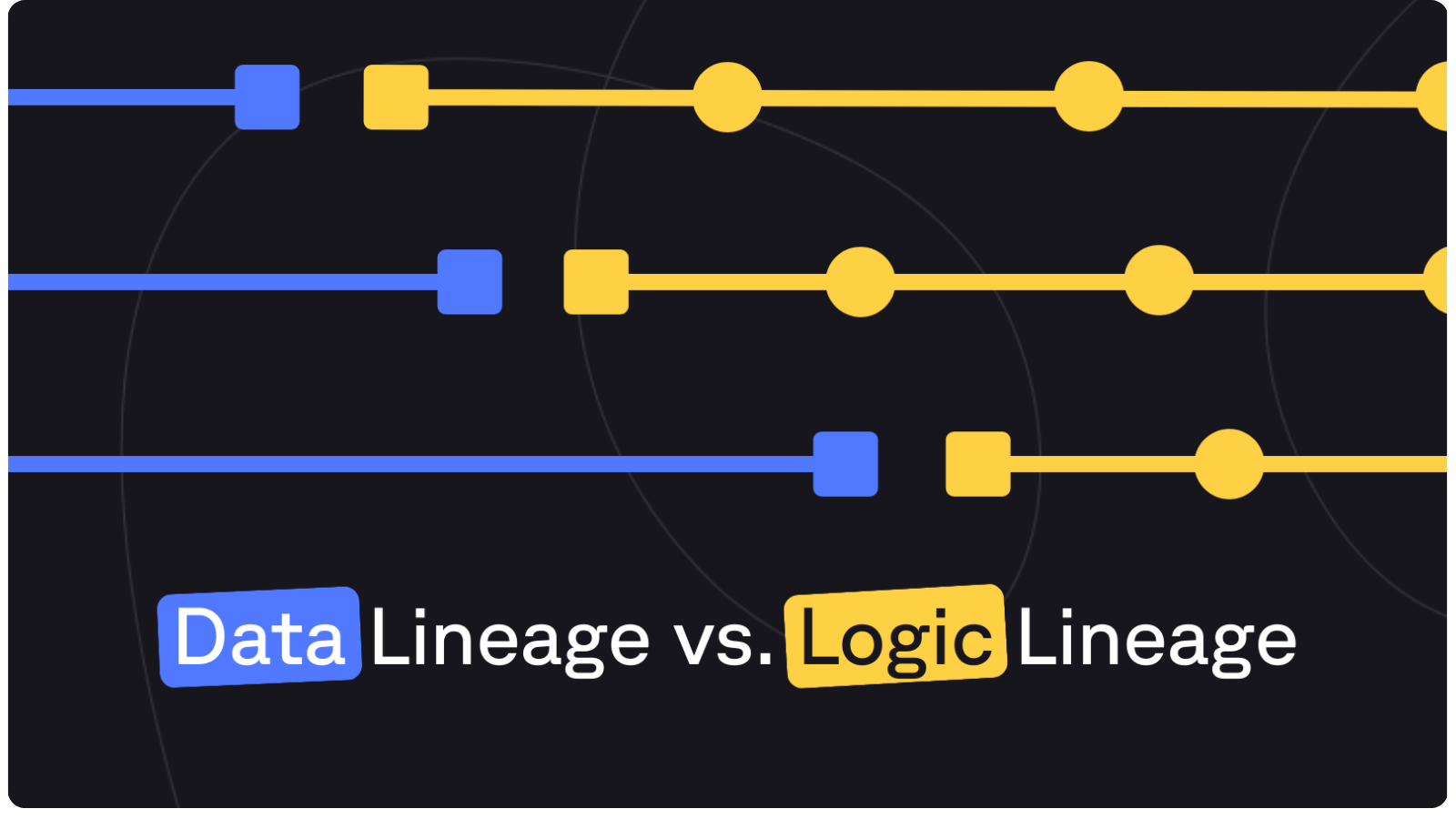
This article explains the difference between data lineage and logic lineage, why data lineage alone isn’t enough to understand how systems behave, and why logic lineage is critical for safe automation and AI agents in modern tech stacks.
TL;DR:
If you happen to find yourself running a modern RevOps or data stack, you probably have a somewhat decent sense of where your data comes from, where it lands, and which dashboards depend on which tables.
You can trace a metric from Salesforce into Snowflake, for instance, and out to BI. You can point to a lineage graph and say, with confidence, this is the path.
That’s real progress. And it solves a real class of problems.
What it doesn’t do? Explain why your system behaves the way it does.
The gap between knowing how data flows and understanding how decisions are made is where most operational pain actually inhabits. And it’s why data lineage and logic lineage are not the same thing, even though they’re often treated (incorrectly) as interchangeable.
At its core, data lineage is about movement.
It tells you where a value originated, which transformations touched it, and where it ends up downstream. For analytics teams debugging a broken dashboard, auditors tracing data provenance, or engineers reasoning about pipeline changes, this visibility is indispensable.
When a field disappears from a report, data lineage helps you identify which upstream sync failed.
When a metric suddenly spikes, it can point you to the source that started behaving differently. In other words, data lineage is excellent at explaining how data flows through systems.
What it does not explain is why the system made a particular decision.
And that distinction matters more than most teams realize.
Most operational failures happen when logic fired in ways people didn’t expect:
From a data lineage perspective, nothing looks wrong. The field is still there. The schema hasn’t changed. The data landed exactly where it was supposed to... But the meaning of that data — and the consequences of changing it — live somewhere else entirely.
That is, they live in your metadata: the rules, automations, validations, and dependencies that turn raw values into business behavior.
Logic lineage is the map of how your systems make decisions.
Instead of tracing data as it moves, logic lineage traces intent as it becomes action. This connects fields to the rules that evaluate them, the automations that respond to them, and the downstream processes that depend on the outcome.
A “Stage” field, for example, isn’t just a string that flows into a dashboard. No, it’s an input to routing rules, forecast categories, approval logic, notifications, and increasingly, AI-driven actions. Changing that value doesn’t just alter a record — it changes your system's behavior.
Logic lineage makes those relationships explicit. It answers questions like: what happens when this field changes? Which logic evaluates it? What breaks if it behaves differently?
Without that visibility, teams are left guessing.
This gap shows up most clearly during “small” changes.
Imagine a Salesforce admin updates a field so that it’s now required instead of optional. There’s no schema change. The field name stays the same. The sync to the warehouse continues as usual.
From a data lineage perspective, this looks harmless.
In production, everything grinds to a halt.
A Flow updates that field after record creation. The validation rule now fires before the Flow runs. Records fail to save. Routing doesn’t happen. An AI agent retries the update repeatedly, triggering more downstream noise and confusion.
Nothing in your data lineage warned you. Absolutely everything in your logic lineage would have.
This is the space most teams live in: the uncomfortable gap between “the data is fine” and “the system is broken.”
Historically, humans have done a decent enough job filling in the gaps.
When something strange happened, someone noticed. Someone remembered an old rule. Someone worked around it using tribal knowledge that never quite made it into documentation.
AI agents, despiter their best efforts, don’t have tribal knowledge.
They act quickly, confidently, and repeatedly. If they don’t understand the logic embedded in your systems — which fields trigger behavior, which rules enforce constraints, which dependencies amplify change — they will make updates that are technically valid and operationally disastrous.
This is why so many so-called “AI failures” aren’t really failures of intelligence.
They’re failures of context.
The agent wasn’t wrong, per se. The system understanding it was given was simply incomplete.
Systems drag isn’t caused by bad tools or slow teams. It’s caused by uncertainty.
When no one can confidently answer, “What will this change affect?”, everything slows down. Reviews take longer. Deploys get postponed. Admins become bottlenecks because they’re the only ones who vaguely remember how things work.
Logic lineage turns that uncertainty into visibility.
When dependencies are explicit and continuously updated, teams move faster because they’re safer. Changes stop feeling like gambles. AI agents operate with real guardrails instead of wishful thinking.
This is what governed speed looks like in practice — not moving slower, but moving with confidence.
Sweep treats lineage as operational infrastructure, not some sort of "documentation theater."
Instead of only mapping where data flows, Sweep maps how logic behaves across your system: which metadata elements depend on each other, how changes propagate, and what business processes are encoded in configuration.
That lineage stays live. As the world changes and as a consequence your org changes, the map updates. As automations evolve, dependencies don’t disappear into stale diagrams or tribal memory.
The result deepens past correct info, into confidence — for admins shipping changes, for RevOps protecting pipeline, and for AI agents that need to act without breaking trust.
If you already have data lineage, keep it. You need it.
Just don’t mistake it for system understanding.
The real question isn’t whether you can trace where data goes. It’s whether you can explain how your system decides, predict the impact of a change before it ships, and give AI agents enough context to act safely.
If you can’t, the problem isn’t your data.
It’s the logic hiding behind it.