

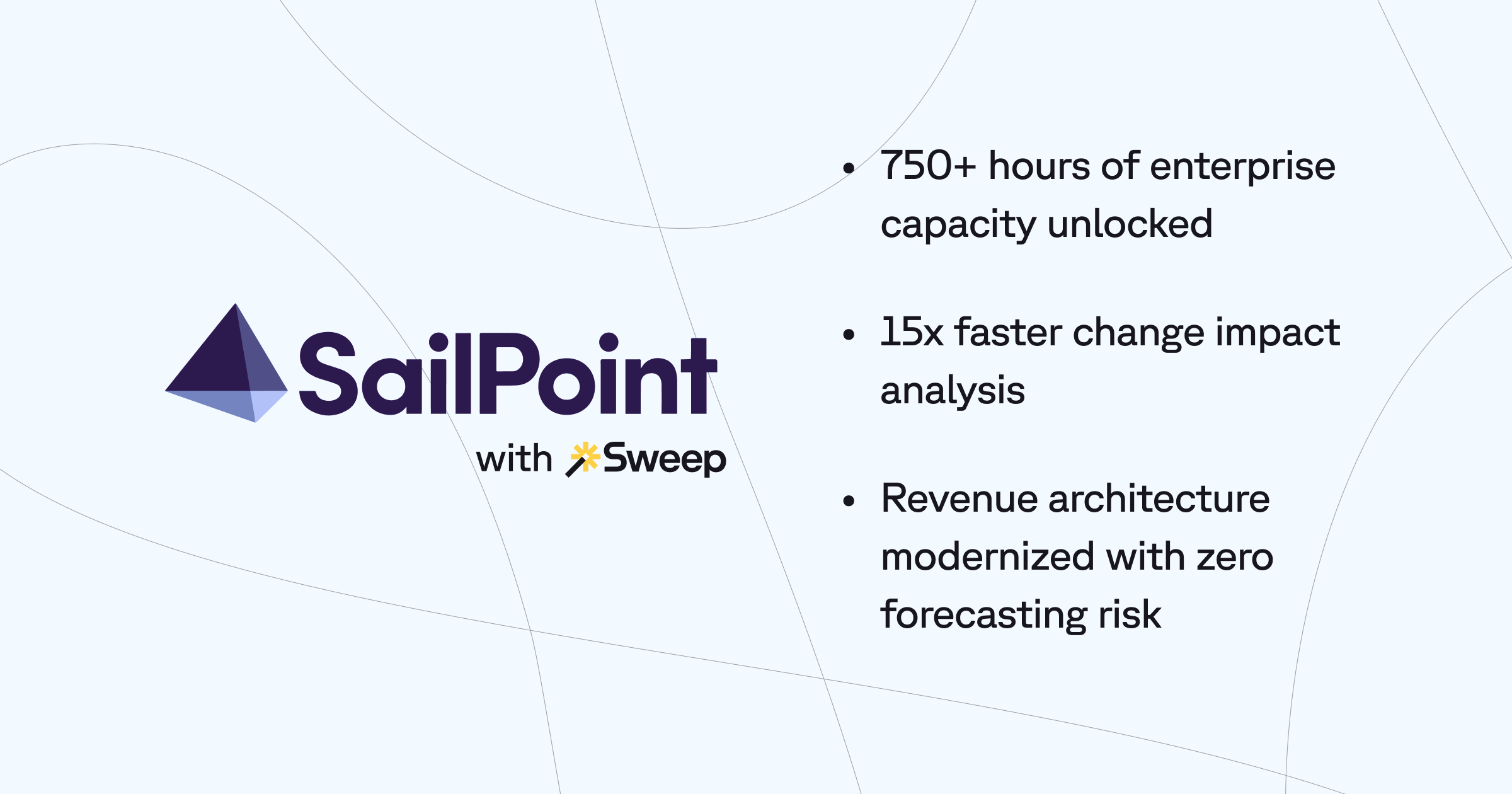
TL;DR: SailPoint modernized core Opportunity architecture during ERP rollout, strict SOX compliance requirements, and IPO preparation. Using Sweep’s Agentic Layer, the team avoided two months of project overrun, accelerated metadata validation 15x, reclaimed 750+ hours of Salesforce capacity annually, and strengthened audit defensibility without adding headcount or introducing forecasting risk.
SailPoint operates in one of the most governance-sensitive environments in enterprise software. As a leader in identity security, the company runs under strict SOX compliance requirements, where Salesforce supports core revenue operations, including Opportunity management, forecasting, quoting workflows, and audit-sensitive access controls.
And it has been in place for nearly two decades.
“Our Salesforce is like 20 years old… any Salesforce that’s been around that long has a lot of tech debt.” — Josie Smets, Head of Revenue CRM, Sailpoint
Over time, the org accumulated divergent Opportunity record types, inconsistent Sales Stage definitions across segments, dozens of validation rules, deeply layered Flows, and redundant permission sets. Much of the original architectural context was no longer documented. Yet Salesforce remained the system of record for executive forecasting and operational reporting.
The timing of the Sales Stage initiative was immediately following the launching of a new ERP system and preparing its systems for IPO-readiness and elevated audit scrutiny. Revenue reporting had to be standardized. Forecast categories had to reconcile cleanly with financial systems. Stage definitions needed to reflect industry standards rather than legacy segmentation.
The initiative was timed around major business milestones. SailPoint was coming out of an ERP rollout and needed revenue reporting to reconcile cleanly across systems. The team also had heightened scrutiny associated with IPO readiness and ongoing public-company compliance expectations (SOX), meaning change needed to be provably controlled and auditable.
The initiative began with a structural objective: reduce and normalize Sales Stages across multiple Opportunity record types. At the time, SailPoint operated with numerous stage variations across Direct, Renewals, Services, and Partner record types. In some cases, identical business milestones carried different stage names across segments.
As Sharon Prager, Salesforce Administrator at SailPoint, described: “It had been a Wild West for the different departments… the same stage, but they would call it something different. To try to do reporting across everything was confusing.”
The goal was to consolidate stages, align Forecast Categories, and establish a unified Opportunity architecture across record types. Given that Salesforce does not allow Sales Stage renaming in place, stages had to be recreated, deactivated, have data migrated, and every downstream dependency updated.
In a 20-year-old org, dependencies extended across validation rules, Flows, Forecast Categories, Apex logic, cross-record-type automation, and fields.
Josie summarized the technical constraint succinctly: “Salesforce is not easy to work with when you need to go find all the dependencies. We couldn’t have downtime. We couldn’t break the system.”
Historically, identifying dependencies meant manual searches across metadata, reviewing Flows individually, scanning validation rules, and building extensive Excel matrices to track impact. The process was time-consuming and inherently incomplete.
The business risk to deploying this initiative was significant. Sales Stages drive forecast calls. Any missed dependency could interrupt sales execution or distort reporting.
“If one thing was messed up and we rolled this out, it could really put a wrench in the sales process… this is how they’re making their forecast call.” — Sharon Prager
The project required absolute precision under timeline pressure.
To modernize its Salesforce revenue architecture, SailPoint had to refactor how Sales Stages, Opportunity record types, automation, and forecasting logic were structured across a 20-year-old Salesforce environment.
This required a coordinated update across Salesforce metadata, automation, and reporting layers.
Project scope included:
Salesforce doesn’t allow in-place Sales Stage renaming. That constraint creates a cascade effect: every dependency tied to a deprecated Stage must be found, rebuilt, and validated against new values.
“You can’t actually rename a sales stage… You have to deprecate an old stage and create a brand new one… it was a domino effect of dependencies.” — Josie Smets
Complicating matters further, the team maintained stage date-stamping fields for key milestones. The legacy model needed to be redesigned to match how the business wanted dates to stamp going forward, requiring careful business alignment and a rebuild of the automation model.
Sweep was initially introduced as a replacement for Troops following Salesforce’s acquisition and pricing shift. However, during early usage, the team recognized Sweep’s broader value.
“We moved forward with it for Slack alerts… then after we got our hands on it we realized, oh, there’s way more to this tool.” — Josie Smets
For the Sales Stage initiative, Sweep became the metadata intelligence layer the team had never had.
Using Sweep, SailPoint was able to:
Sharon described the experience of working through configuration questions: “We had changes up until the time we rolled it out. Being able to cross-reference everything through Sweep… there’s no way we could have done this project without Sweep. At one point… I said, I think you’ve just out-Salesforced Salesforce.”
Beyond dependency mapping, Sweep became a translation layer between Salesforce configuration and business stakeholders. Josie explained: “Sweep speaks in a language that you could hand back to the business… I’ll take screenshots and say, ‘this is how the field’s getting updated,’ and they’re like, ‘oh cool, that makes total sense.’”
SailPoint successfully standardized Sales Stages across multiple Opportunity record types in a 20-year-old Salesforce org, without disrupting forecasting, reporting, or sales execution.
The rollout completed on schedule, with no downstream failures, forecast inconsistencies, nor extended remediation cycles.
As Josie put it: “It was quiet. Nobody came back and said you didn’t do XYZ… that’s when you know a project’s successful with Salesforce.”
That outcome is significant in a mature Salesforce environment. In legacy orgs, structural changes to architecture often surface missed dependencies weeks or months after deployment. Without Sweep, both Josie and Sharon were clear that this would likely have been the case.
“We would have been cleaning up months afterwards… we would have missed a lot of the dependencies.” — Josie Smets
“There’s no way we could have done this project without Sweep.” — Sharon Prager
Beyond the stage initiative, Sweep permanently changed how SailPoint manages Salesforce change.
Every configuration request now undergoes rapid metadata validation before development begins. What previously required manual inspection of validation rules and Flows now takes minutes.
“It gives you the answer in 2 minutes… it would have taken you 30 minutes to go dig and find all this.” — Josie Smets
That 15x acceleration has materially expanded the team’s capacity without adding headcount.
At an operational level, this translates to:
| Impact Area | Business Outcome |
|---|---|
| Scope Handled | 23+ stages at kickoff; ~30 stage edits; 25 workflows → Flow; 25 validation rules; 20 fields deprecated + 15 added |
| Opportunity Architecture Standardization | Standardized 23+ Sales Stages across 4 Opportunity record types while preserving forecast integrity |
| Change Velocity | Impact analysis accelerated 15x (30 minutes → 2 minutes) |
| Capacity Reclaimed | Reclaimed 750+ hours annually (~4–5 months of Salesforce capacity) |
| Risk Reduction | Eliminated post-deployment remediation cycles |
| Headcount Added | 0 |
Combined, SailPoint reclaimed 750+ high-value operational hours in the first year alone — equivalent to nearly 4–5 months of full-time Salesforce capacity — without increasing headcount.
Sweep has become embedded into SailPoint’s Salesforce operating model.
It is now used to:
The team is preparing to extend Sweep’s capabilities further by deploying User Support Agents directly within Salesforce to reduce repetitive support tickets and enable guided self-service.
Josie summarized the trajectory: “Everything you guys have done, I see value in… we’re integrating more and more.”
For Sailpoint, Sweep represents the metadata intelligence layer that enables safe change in a highly customized enterprise Salesforce environment, where forecasting accuracy, compliance posture, and operational continuity cannot be compromised.
If you're navigating Salesforce technical debt, Sales Stage standardization, ERP alignment, or forecasting risk, Sweep helps you map dependencies, validate impact, and deploy changes with confidence. Book a demo today.