
TL;DR:
Every Salesforce team eventually runs into the moment where someone says, “Can’t we just undo it?”
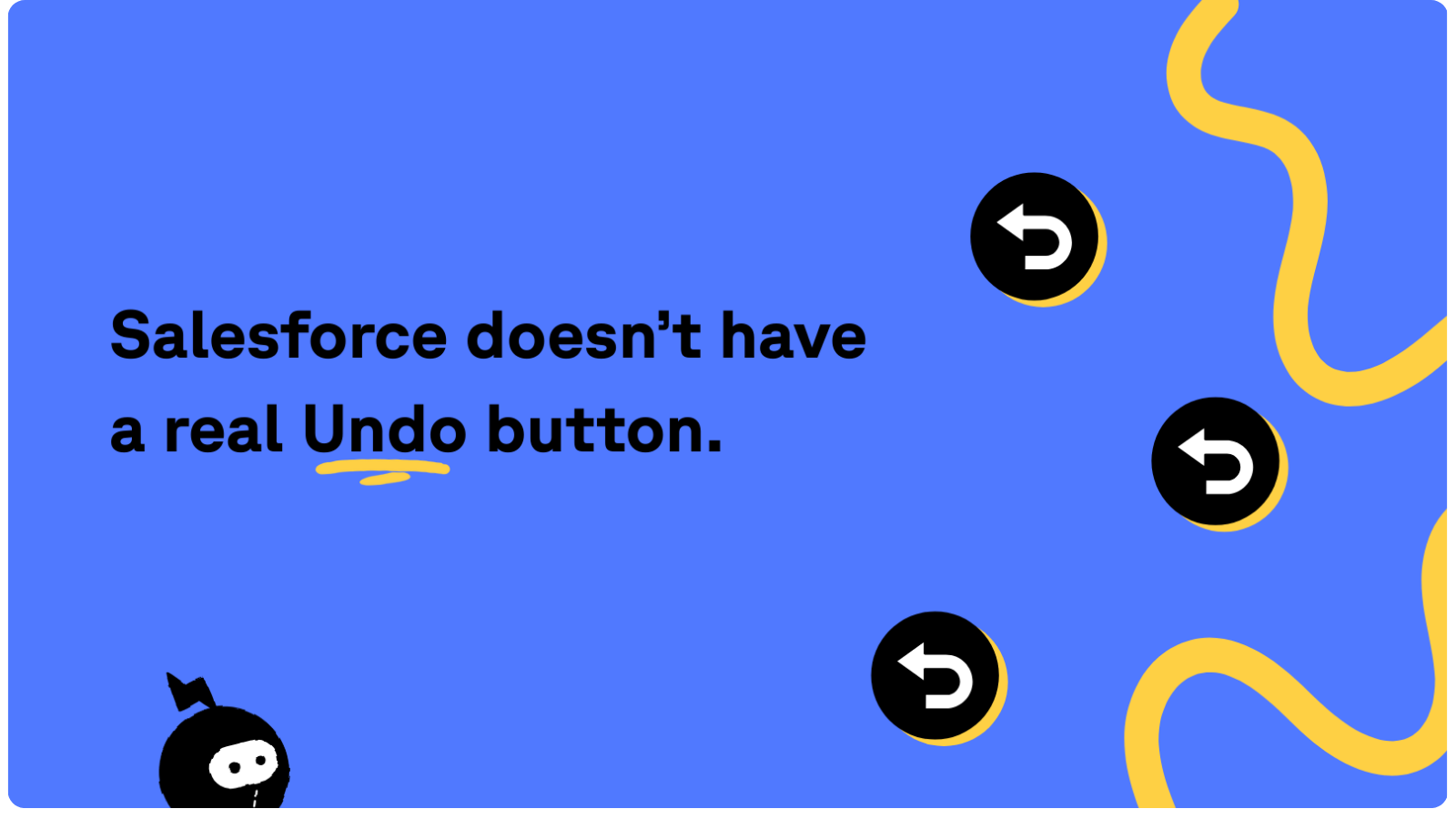
It’s usually after a deployment causes a ripple effect no one expected — a broken flow, a blocked integration, a quote process refusing to fire. And the room collectively remembers what newcomers don’t yet know: Salesforce doesn’t have a real undo button.
The reason is largely architectural.
That is, Salesforce does not track enough metadata history, lineage, or context to make a rollback predictable. And when metadata is the business logic, the absence of context turns undoing a change into one of the riskiest moves in the entire platform.
Salesforce metadata is a living system made of interdependent pieces. A single field can be referenced by a flow, an Apex class, a formula, a validation rule, a CPQ rule, and a reporting framework. Remove or revert that field and you don’t just change a data point — you unwind the logic that depends on it.
This is why teams describe rollbacks as “Jenga in the dark.” Each change is technically reversible, but the risk is that pulling one block destabilizes several layers you didn’t know were connected.
Audit Trail doesn’t fix this problem. It only stores a snapshot of what changed but never explains why it changed, how it interacted with the rest of the org, or what else depends on that metadata today. You can scroll through a list of events and still have no idea which reversal is safe.
Salesforce teams don’t usually fail rollbacks because they’re careless. They fail because the system’s complexity is invisible. A small adjustment intended to improve one workflow can quietly undermine another.
A validation rule designed for one customer segment might disrupt a billing integration...
A slight CPQ tweak can cascade into pricing logic across objects...
A reversed flow version may not align with new dependencies introduced since its last deployment.
And because Salesforce does not maintain a complete historical record of the org’s metadata model, teams have no way to see this coupling until something breaks. Many orgs carry years of drift, half-implemented processes, obsolete automations, and tribal knowledge that once lived in an architect’s notebook but didn’t survive turnover.
This is the shadow metadata layer — the undocumented logic that's running the business — and it’s where rollbacks most often go wrong.
In an ideal world, reversing a change in Salesforce would resemble version control. You’d have complete context: what changed, how it interacts with upstream and downstream dependencies, what’s drifted since, and what risks the reversal introduces.
Instead of reconstructing the past, you’d consult it.
Instead of diffing sandboxes, you’d inspect a lineage map.
Instead of guessing about impact, you’d see it.
Because ultimately, a rollback is not about restoring a previous state — it’s about preserving system integrity without introducing new failures.
Salesforce’s ecosystem provides you with a pretty powerful DevOps tool kit, but none of it captures the one thing rollbacks actually require: metadata intelligence.
Audit Trail provides partial history for a limited window of time. It cannot express intent, context, or relationships.
Sandbox comparison tools show differences but not the architectural meaning behind them.
DevOps tools focus on deployments, not the logic’s purpose or the cascading dependencies tied to that logic.
And documentation, as every admin knows, decays the moment it’s created.
These gaps create a world where teams can move forward confidently but struggle to safely move backward.
Sweep solves the rollback problem at the structural level: it gives Salesforce a self-understanding of its metadata.
This is the shift that transforms reversals from high-risk operations into routine, governed workflows.
Sweep’s Change Feed captures every modification across flows, fields, automations, CPQ rules, and permissions. There’s no six-month cap, no partial logging, and no missing intent. If something changed, you see it — and you see the context around it.
Our lineage and dependency mapping in the Visual Workspace reveal how metadata fits together, what references what, and which parts of your org depend on the change you want to reverse. Instead of guessing, you navigate a living blueprint.
Continuous drift detection shows what has shifted since the original deployment. If a rollback introduces new risk, Sweep identifies it before it becomes a production problem.
And metadata agents add the missing layer of reasoning.
These little fellas analyze change history, surface dependency risks, and generate rollback notes that explain what happened and how to safely undo it. Humans maintain decision authority; the agents handle complexity no human can realistically track.
Rollbacks are truly the first test of whether an org can safely support autonomous or semi-autonomous AI agents inside Salesforce.
AI cannot operate in an environment where:
If undoing a change is risky, automating a change becomes nearly impossible.
Sweep’s agentic metadata layer establishes the conditions for trustworthy AI: full context, clear lineage, predictable reversibility, and explainable system behavior. Rollbacks become a governance function rather than a fire drill. And AI becomes a multiplier — not a liability.
If your org wants safer rollbacks (and by now they should) the first step is clarity.
Monitor metadata continuously. Replace shallow audit logs with infinite change history. Use lineage as part of every planning conversation. Centralize documentation so decisions survive personnel changes. And bring metadata agents into your investigation loop so you’re not relying on intuition for high-stakes decisions.
With the right foundation, a rollback isn’t a gamble. It’s a controlled operation supported by real-time insight — and the cornerstone of safe automation in Salesforce.
Wanna see how we do it here at Sweep? Book a demo right here and we'll happily walk you through it.