
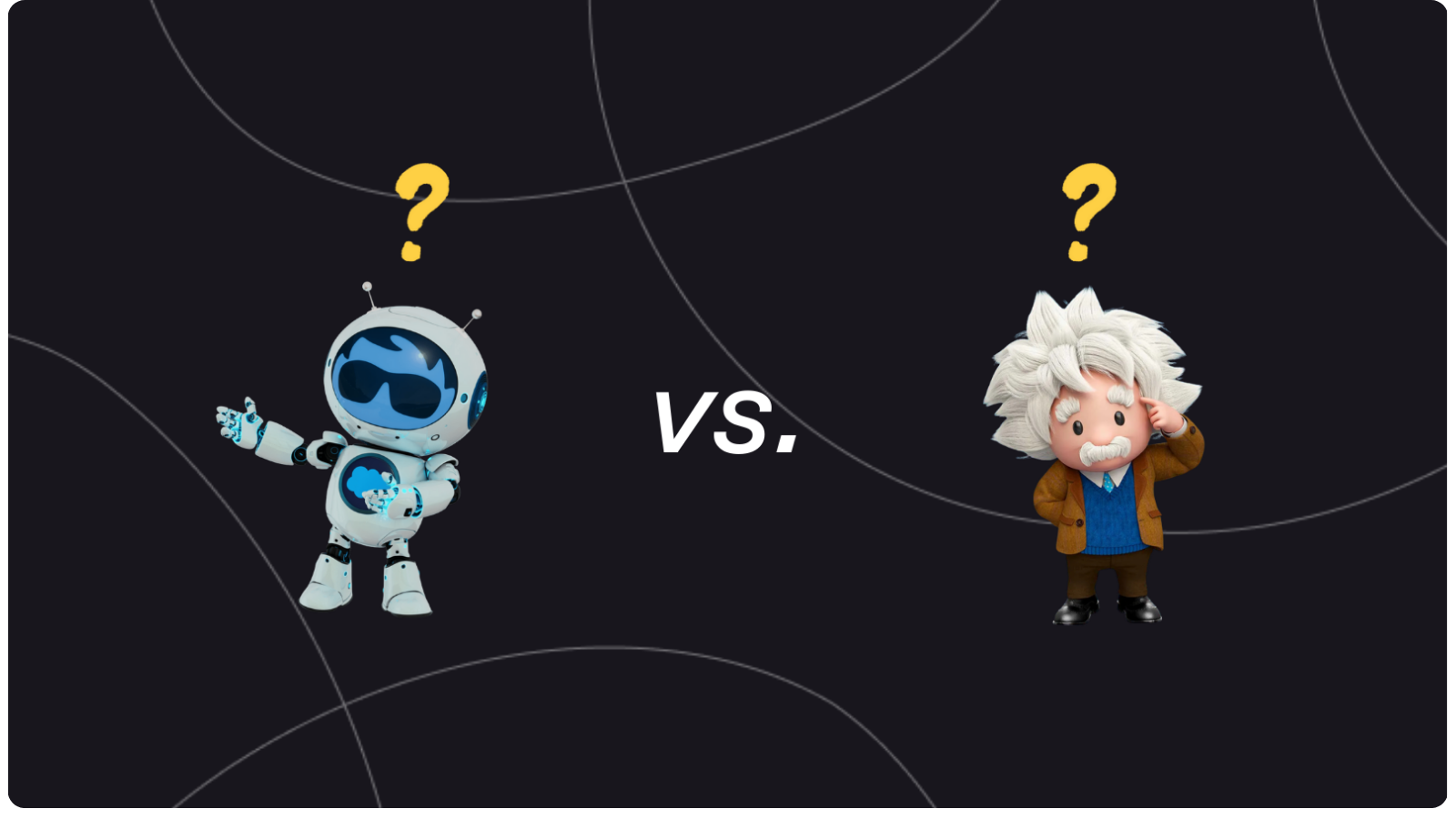
Salesforce now operates two very different AI models: Einstein Copilot, a predictive system that interprets information, and Agentforce, an agentic system that takes action inside your CRM. This guide explains the architectural split between the two — and why safe agentic execution depends entirely on clean, consistent, governed metadata. It also outlines how tools like Sweep’s active metadata layer prepare teams for reliable AI.
Einstein Copilot follows the classic LLM arc: text in → retrieve → reason → text out. It does not build a structural model of your Salesforce environment, nor does it simulate consequences.
Because it never takes action, it doesn’t need to understand:
Copilot is great for interpretation tasks:
Predictive models can be confidently wrong because nothing breaks.
This is why Copilot feels safe — the blast radius is small.
Agentforce is different because its output is not language — it’s system change.
An Agentforce agent:
To do this safely, it must understand your org’s metadata the same way a seasoned architect would.
That means a grounded world model of:
Where Copilot retrieves, Agentforce must simulate.
Where Copilot predicts, Agentforce must understand.
Where Copilot can guess, Agentforce must not.
This is why Salesforce built the Atlas Reasoning Engine specifically for Agentforce — execution requires context, and context lives in metadata.
If you want the deeper background on AI readiness and metadata, check out "The Ultimate Guide to AI Readiness in Salesforce."
Predictive AI tolerates a mess. Agentic AI vomits when it digests it (so to speak). That is, agents fail for one primary reason: the agent’s internal model of your org no longer matches the reality of it.
That mismatch comes from:
Copilot can ride above this ambiguity — it’s summarizing, not changing things.
Agentforce can’t.
This is why Salesforce teams are suddenly prioritizing:
These aren’t DevOps "niceties" anymore. They’re the final safety rails to prevent agentic AI from failing.
Copilot interprets; Agentforce acts.
Copilot works on data; Agentforce works on metadata + process logic.
Copilot can hallucinate; Agentforce must be correct.
Copilot tolerates ambiguity; Agentforce requires coherence.
Copilot outputs text; Agentforce outputs stateful change.
Predictive systems hallucinate. Agentic systems break things.
This is why technical leaders evaluating “AI readiness” can’t treat both systems the same.
Most companies still ask:
“Is our data clean enough for AI?”
But the real gating factor is:
Is our metadata clear, consistent, and governed enough for an AI agent to operate safely?
Metadata is the lens through which Agentforce sees your org.
Metadata governance is the act of cleaning that lens.
If definitions drift, if logic hides inside flows, if dependencies are undocumented — the agent will get confused, freeze, or misfire.
If you want a practical playbook for improving your readiness, check out this handy checklist.
Agentforce adoption won’t be limited by LLM quality.
It will be limited by metadata quality.
To make agents trustworthy, organizations need:
Agentforce depends on a metadata substrate that is stable, legible, and machine-readable.
This is why metadata is quickly becoming the new operational bottleneck — and the new strategic advantage.
Sweep provides the agentic metadata layer that Agentforce relies on. It unifies, updates, and explains your org’s metadata so agents can reason safely and act confidently.
Sweep automatically maps every object, field, flow, rule, dependency, and semantic definition — giving both humans and agents a grounded world model of your org.
Sweep detects metadata drift, logic inconsistencies, mismatched definitions, and high-risk dependencies before an agent encounters them.
Every change becomes explainable, traceable, and reversible.
This is the governance foundation Agentforce needs for safe execution.
(Explore Sweep’s approach to automated documentation here.)
Here's an easy way to think of it: Data powers predictive AI. Metadata powers agentic AI.
Agentforce will transform how organizations operate — but only where metadata is:
The cleaner the metadata layer, the more powerful Agentforce becomes — because its world model becomes significantly more trustworthy.