

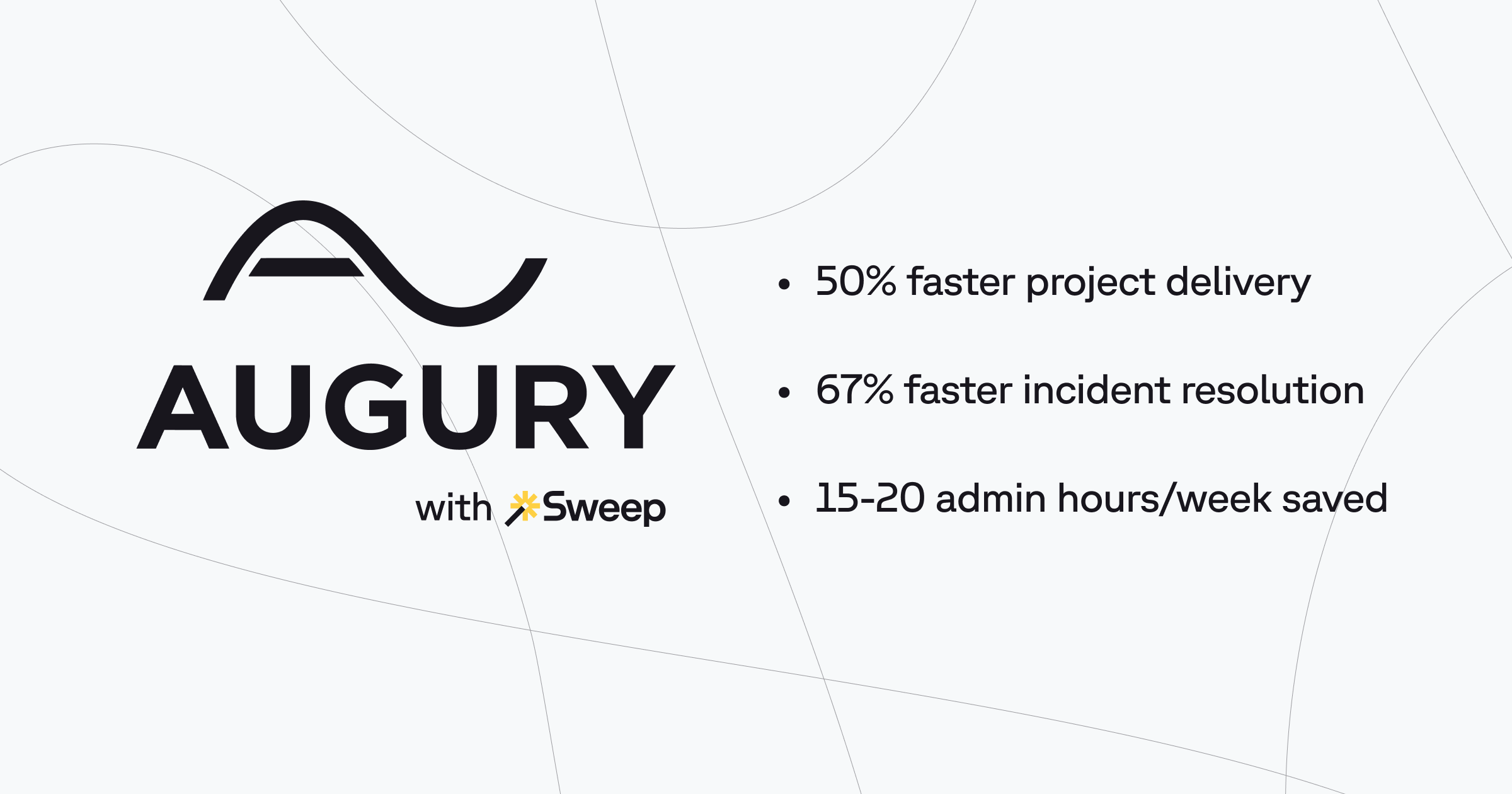
TL;DR: Augury cut Salesforce delivery time in half using Sweep’s Agentic Layer accelerating projects, resolving incidents 67% faster, and reclaiming 15–25 hours of Admin + RevOps time each week.
*
Augury is a global machine-health company where Salesforce sits at the center of Go-to-Market (GTM) and service operations. Revenue Operations and Business Systems teams support this highly customized Salesforce environment powering Sales Cloud, Field Service, and operations across multiple regions. As the org evolved and inherited years of automation and technical debt, investigations, impact analysis, and troubleshooting began consuming more time than strategic work.
Key results:
Salesforce sits at the center of Augury’s GTM and service operations, powering Sales Cloud, Field Service, partner workflows, and multi-regional processes. Two teams manage the platform:
Business Systems, led by Eric Cirincione, owning Salesforce configuration and architecture, and Revenue Operations, led by David Thai, supporting ~150 Salesforce users across GTM, delivery, and finance.
“Balancing my workload was really difficult,” Eric said. “I was expected to come up with a roadmap and a plan, as well as being an individual contributor putting out fires… that’s definitely where Sweep has helped me a ton.”
Before Sweep, both teams were navigating a decade of undocumented Salesforce changes.
For Eric and the admin team, impact analysis and troubleshooting could consume 24 to 48 hours for a single issue, especially in complex flows. A consolidation reduced the Salesforce team from five people to two, including the loss of their most tenured admin — and with them, years of tribal knowledge.
For RevOps even “simple” changes were slow and risky. Updating a field could take around two weeks due to manual mapping of downstream dependencies. Investigations into flows, triggers, and fields often took 2–3 weeks.
“There was always this painstaking process of understanding the historical context of how our system worked,” David said. “It felt like navigating in the dark.”
Both teams were forced to trade off strategic work (roadmap, process design, enablement) against investigative work (debugging, impact analysis, documentation).
Instead of adding headcount, Augury turned to Sweep’s Agentic Layer to effectively add another brain inside Salesforce. David describes Sweep as “an almost omnipotent, omniscient being living in your Salesforce, giving you all the answers instantly.
Sweep now documents configuration, explains flow logic, surfaces dependencies, and generates fully-audited requirements. “It transformed our business requirements,” Eric said. “Users now consult Sweep before submitting requests. Everyone is shocked at how fast we turn around items.”
For David, Sweep elevated RevOps into an architecture-capable function: “I can pop open the hood on a decade of systems architecture… it’s allowed me to take on the role of an architect myself.”
Sweep’s impact analysis and dependency mapping has prevented real production risk. During a wave of C-suite changes, a seemingly simple field rename was requested. Sweep flagged that the field was used in a critical outbound integration, as Eric explains, “I put the metadata label into Sweep, and it showed me it was involved in an outbound message… it prevented me from making that change on the fly.”
In another case, a complex flow level bug — “a bit of a nightmare,” in Eric’s words — that historically would have required engineering and multiple days of debugging was resolved in a single day after Sweep surfaced the right filter criteria on an obscure node. “It went from 2–3 days’ turnaround to a day… greater than 50% reduction.”
On the RevOps side, investigations that once took 1–3 weeks now take seconds. “RevOps can understand everything within our Salesforce instance within a few seconds whenever the Agentic Layer loads the output,” David said. “Projects always had this investigative phase that took several days. Now that’s essentially gone.”
With process and metadata clarity, requirements arriving to Business Systems are now complete, accurate, and fully audited. Eric said: “It’s put us into hyperdrive… everyone’s been shocked at how fast we’ve been turning around their items.” He’s also seen “a very large reduction in tickets” that involve investigation, impact analysis, and scoping.
At the same time, Augury has simplified its GTM stack. Tools used for Slack alerts and lead routing have been replaced by Sweep: “The consolidation helps us save not just money, but also opportunity cost overall. The RevOps team can work out of one platform rather than a multitude of tools.”
David estimates that in the six months since adopting Sweep, RevOps has shipped more deployments and enhancements than in the entire prior year. “Sweep helps me save at least 2–3 hours a day,” David said. “We can handle more volume and execute at greater speed.”
| Area | Measured Impact |
|---|---|
| Delivery Speed | Project timelines cut 50% (14 → 7 days) |
| Issue Resolution | Incident resolution up to 67% faster |
| Change Velocity | Field/flow changes 2× faster (2 weeks → 1 week) |
| Investigation Time Saved | 15–25 hours/week reclaimed (Admin: 5–10, RevOps: 10–15) |
| Complex Troubleshooting | 1–3 week investigations reduced to seconds |
| Deployment Throughput | 2× more deployments delivered in 6 months |
| Tool Consolidation | Consolidated third party routing & alerts tools into Sweep’s workspace |
Sweep has become Augury’s shared metadata intelligence layer, enabling Admin and RevOps to evolve Salesforce quickly, safely, and with confidence.
Eric summed it up: “To have these tools now has changed my life and my perspective on the job. Sweep is a vital tool in the Salesforce admin belt.”
David added: “We’re moving with such velocity and such a quick tempo… and we feel safe working at this speed because 95–99% of what we usually audit for is surfaced almost immediately with Sweep.”